Skip to content
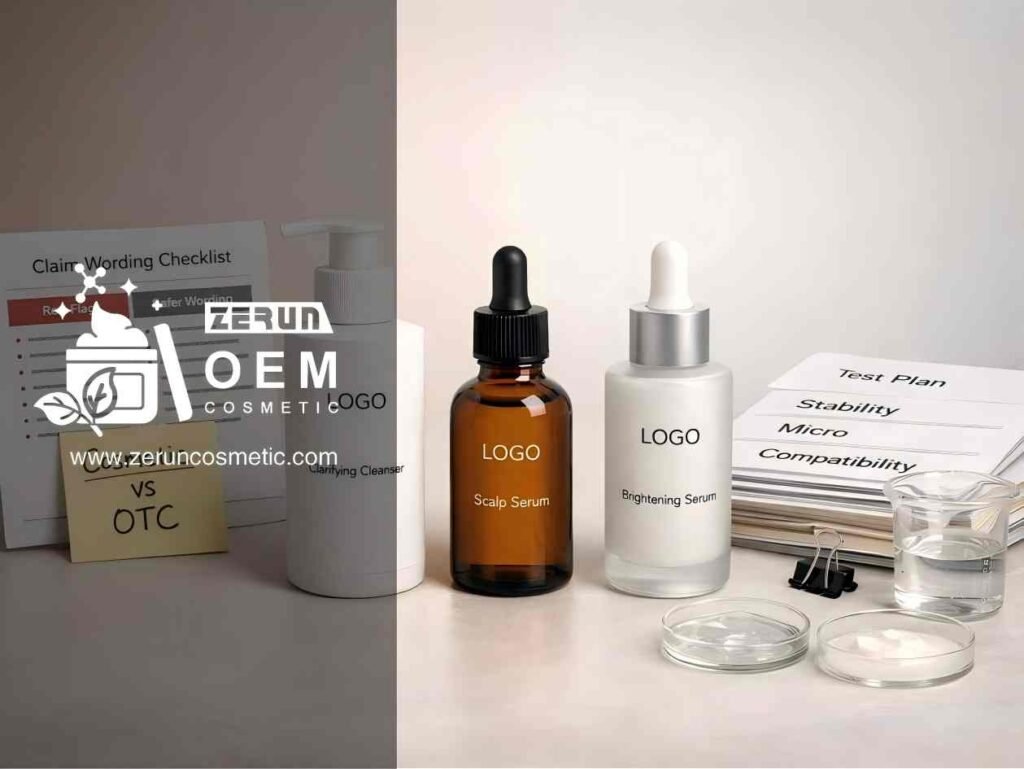
If you’re building products for the US market, “claims” are not just marketing. They are a regulatory signal that can change your product category, your required documentation, your testing plan, and even how fast you can launch.
The painful part is that many brand teams don’t intend to go OTC—yet a few words like “treat,” “cure,” “prevent,” “regrow,” or “kills acne bacteria” can accidentally communicate “drug intent.” That’s why this guide is written from a manufacturer’s engineering lens: claims → formula choices → packaging compatibility → testing evidence → scale-up readiness.
In the US, a product’s intended use—often implied by your wording—determines whether it stays a cosmetic or drifts into drug/OTC territory. This checklist helps you keep acne, hair loss, and brightening messaging “cosmetic-safe” : you’ll get red-flag wording to avoid, safer alternatives to use, and an evidence map (tests + documents) you can request from your factory and labs.
What exactly makes a cosmetic claim become a drug/OTC claim in the US?
A cosmetic can quickly look like a drug/OTC when claims imply treating or preventing a disease or affecting the body’s structure/function—even if your formula is “cosmetic-like.” Regulators infer intent from wording, labeling, and marketing context.
What your product is presented to do, based on your claims and marketing. If your message implies diagnosis, cure, mitigation, treatment, or prevention of a condition—or a physiological change—risk increases.
Fast self-check:
- If your claim uses treat/cure/heal/prevent language → Then you’re likely signaling drug intent.
- If your claim focuses on appearance (looks clearer, feels smoother, less visible) → Then you’re typically in cosmetic territory.
- If you mention a disease/medical condition (acne as a disease treatment context, alopecia, dermatitis, etc.) → Then risk increases—wording and context matter a lot.
- If you pair claims with medical cues (dosage-style directions, “clinically proven to treat…”) → Then you may be drifting further toward drug framing.
Table: Cosmetic-type wording vs Drug/OTC-type wording
| Red-flag wording (higher risk) | Safer cosmetic-style alternatives (appearance/feel) |
|---|---|
| “Treats acne” / “Cures acne” | “Helps reduce the appearance of blemishes” |
| “Prevents acne” | “Helps keep pores looking clear” / “Helps minimize the look of breakouts” |
| “Antibacterial for acne” / “Kills acne bacteria” | “Helps cleanse away impurities” / “Helps control excess oil” |
| “Stops hair loss” | “Helps reduce the look of shedding due to breakage” |
| “Regrows hair” / “Restores hair growth” | “Hair looks fuller” / “Improves the appearance of thickness” |
| “Bleaches skin” / “Eliminates melanin” | “Brightens the look of dullness” / “Evens the look of tone” |
| “Treats hyperpigmentation” | “Helps dark spots look less noticeable” |
For acne products, which claims are highest-risk—and what safer wording still converts?

Acne is one of the most “claim-sensitive” categories. Risk spikes when you promise treatment/prevention, mention bacteria killing, or frame acne as a medical condition. You can still sell by switching to appearance + oil/pores + comfort language.
Why acne claims go wrong?
Most acne launches fail compliance not because of ingredients, but because teams mix:
- Medical promise (“treat acne,” “cure pimples”)
- Mechanism promise (“kills acne bacteria,” “anti-inflammatory for acne”)
- Outcome certainty (“guaranteed clear skin in 7 days”)
Table: Acne Claim Wording Swap
| Red-flag acne claims (higher risk) | Safer cosmetic alternatives (still persuasive) |
|---|---|
| Treats acne / Cures acne | Helps reduce the appearance of blemishes |
| Prevents acne / Stops breakouts | Helps keep skin looking clear / Helps reduce the look of future blemishes* |
| Antibacterial for acne / Kills acne bacteria | Helps cleanse away impurities / Helps remove excess oil |
| Anti-inflammatory acne treatment | Helps soothe the look of redness / Helps calm stressed-looking skin |
| Unclogs pores to treat acne | Helps refine the look of pores / Helps keep pores looking clean |
| Clears acne fast / Guaranteed clear skin | Helps improve the look of clarity over time / Helps support a clearer-looking complexion |
- Tip: phrases like “reduce the look of future blemishes” are still sensitive—keep the framing appearance-based, avoid absolute prevention claims, and ensure your evidence supports the wording.
Checklist card: “Acne claims safe enough to scale?”
Keep these three rules before you lock copy:
- Rule 1 (Outcome framing): describe appearance (look/feel), not medical treatment.
- Rule 2 (Mechanism restraint): avoid “kills bacteria” style claims unless you’re prepared for drug-like scrutiny.
- Rule 3 (Consistency): align claim wording with your directions, label tone, and imagery (no medical cues).
Acne claims become highest-risk when they promise “treat/cure/prevent acne,” mention killing bacteria, or guarantee clearance—those signals can read like drug intent; safer cosmetic copy stays appearance-led (blemishes look reduced, pores look clearer, oil looks controlled) and is easier to substantiate. Start with acne formulation capability, align messaging to a hero SKU like private label acne serum, and anchor the claim story to evidence-friendly actives such as salicylic acid ingredient support.
What evidence types can support “acne-adjacent” cosmetic claims without crossing into drug territory?
The safest cosmetic acne-adjacent claims are supported by appearance-based consumer studies, instrumental skin measures (oil/shine/appearance), and photo-grading, plus the basics (stability, micro, compatibility). Match evidence to the exact wording you use.
The “proof ladder” (use the lightest proof that truly supports your claim)
- Level A — Consumer perception (fastest): “Skin looks clearer,” “Feels less oily,” “Looks calmer”
- Level B — Instrumental signals (stronger): sebum/shine metrics, redness appearance scoring, pore appearance grading
- Level C — Clinical-style endpoints (highest scrutiny): avoid framing that implies disease treatment unless your pathway is built for it
Table: Evidence Matrix — Acne-adjacent cosmetic claims
| Claim type (cosmetic-safe framing) | Best evidence type | Typical study design | What to request from factory/lab |
|---|---|---|---|
| “Helps reduce the appearance of blemishes” | Photo grading + consumer perception | 2–4 weeks, before/after photos, blinded grading rubric + survey | Photo protocol, grading method, claim-support summary |
| “Helps control excess oil / shine” | Instrumental + consumer | Sebum/shine measurements + user self-assessment | Instrument report + consumer results |
| “Helps refine the look of pores” | Photo grading + consumer | Standardized lighting photos + perception questionnaire | Imaging protocol + results summary |
| “Helps soothe the look of redness” | Appearance scoring + consumer | Visual redness scoring + comfort questionnaire | Scoring rubric + sensitivity/irritation notes |
| “Gentle for daily use” / “Non-stripping feel” | Consumer + tolerability screen | 1–2 weeks, comfort/irritation diary | Tolerability notes, adverse event logging method |
| “Helps keep skin feeling balanced” | Consumer | 2–4 weeks, structured consumer survey | Full questionnaire + topline claim support |
Minimum “manufacturing-ready” QA evidence (even for cosmetic positioning)
Even if you stay cosmetic, buyers and platforms increasingly expect a disciplined baseline:
- Stability plan (so claims don’t collapse due to phase separation/odor/color drift)
- Microbial safety controls (appropriate preservative strategy + verification)
- Packaging compatibility (especially for acidic systems / solvents / essential oils)
- Batch-to-batch consistency (so results match future production runs)
For hair loss/hair growth, which words most often trigger drug intent—and what alternatives should you use?

Hair-loss messaging becomes high-risk when it promises regrowth, restoration, stopping hair loss, or implies treating a medical condition. You can still convert by focusing on breakage, density appearance, scalp comfort, and healthier-looking hair.
Why hair claims are “OTC-sensitive”?
Hair is tricky because consumers search in “treatment language,” but cosmetics must usually stay in appearance + feel territory unless you deliberately pursue a drug/OTC pathway. The fastest way to get into trouble is to combine:
- Outcome certainty (“regrows hair,” “stops hair loss”)
- Medical framing (“treats alopecia,” “clinically proven to regrow”)
- Mechanism claims (“reactivates follicles,” “stimulates hair growth at the root”)
Table: Hair Loss Claim Wording Swap
| Red-flag hair claims (higher risk) | Safer cosmetic alternatives (appearance/feel) |
|---|---|
| “Stops hair loss” | “Helps reduce the look of shedding due to breakage” |
| “Treats hair loss” / “Treats alopecia” | “Helps support stronger-looking hair” / “Hair looks healthier and fuller” |
| “Regrows hair” / “Restores hair growth” | “Improves the appearance of thickness” / “Hair looks denser over time” |
| “Stimulates follicles” / “Reactivates dormant follicles” | “Helps support a healthy-looking scalp environment” |
| “Repairs hair loss at the root” | “Helps reduce breakage and improve resilience” |
| “Clinically proven hair growth” (if your evidence is only cosmetic-level) | “Clinically tested for the appearance of fuller-looking hair” (only if you truly have the right study design) |
Checklist card: Hair-loss claims that stay “cosmetic-safe”
Before you lock packaging copy or Amazon bullets, ensure:
- You never promise “regrowth.”
- You anchor improvement to breakage, strength, thickness appearance, or scalp comfort.
- Your directions don’t look like dosing (avoid “apply to scalp twice daily for treatment…” style phrasing).
Hair-loss claims become high-risk when they promise “regrowth,” “restore hair growth,” or “stop hair loss,” because that reads like drug intent; safer cosmetic copy focuses on breakage, fuller-looking hair, and scalp comfort. Start with hair-loss formulation capability, map claims to a hero SKU like private label hair loss treatment, and support the barrier/soothing story with Panthenol ingredient support.
What evidence supports scalp + hair “appearance” claims (density, breakage, shedding look) without “regrowth”?
Support cosmetic hair claims with breakage reduction testing, combing-force/strength measures, before-after photography with standardized protocols, and consumer perception. The evidence must match the wording—avoid endpoints that imply disease treatment.
The “hair proof” rule: match evidence to what you say
- If you say “reduces breakage” → you need breakage/strength testing (not just a survey).
- If you say “looks fuller/denser” → you need standardized photos + panel grading + consumer feedback.
- If you say “supports a healthy-looking scalp” → you need tolerability + comfort measures, and avoid “treats scalp conditions” language.
Table: Evidence Matrix — Hair/Scalp cosmetic claims
| Claim type (cosmetic framing) | Best evidence type | Typical study design | What to request from factory/lab |
|---|---|---|---|
| “Helps reduce breakage” | Instrumental hair-fiber testing | Tress testing, breakage count, tensile strength | Test report + method + sample prep details |
| “Hair looks thicker/denser” | Photo + expert grading + consumer | Standardized photo booth, fixed hairstyle instructions, 4–8 weeks | Photo protocol + grading rubric + topline results |
| “Improves manageability / less shedding look” | Combing-force + consumer | Wet/dry combing force + user-reported shedding appearance | Combing-force report + questionnaire |
| “Scalp feels less itchy / more comfortable” | Consumer + tolerability | Comfort diary + irritation logs (2–4 weeks) | Adverse event logging + tolerability summary |
| “Hair looks healthier / shinier” | Gloss measurement + photos + consumer | Instrumental gloss + standardized photos | Gloss report + photo method + results summary |
What NOT to do if you want to stay cosmetic
- Don’t use endpoints like “treats alopecia” or “restores growth” unless you’re building an OTC pathway.
- Don’t imply follicle activation or medical reversal in copy, graphics, or product naming.
For brightening, what’s the difference between “brightening”, “lightening”, and “dark spots”—and which is riskier?

“Brightening” is usually framed as reducing dullness and improving radiance (appearance). “Lightening/bleaching” sounds more like altering pigmentation in a definitive way, and “dark spots” claims need careful phrasing. Safer copy focuses on even-looking tone and less noticeable spots.
Why brightening claims drift into trouble
Brightening is high-demand, but copy often slips into:
- Absolute transformation (“removes melanin,” “permanently erases spots”)
- Medical framing (“treats hyperpigmentation/melasma”)
- Guaranteed outcomes (“visible whitening in 7 days”)
Table: Brightening Claim Wording Swap
| Red-flag brightening claims (higher risk) | Safer cosmetic alternatives (appearance/feel) |
|---|---|
| “Whitens skin” / “Skin whitening” | “Brightens the look of dullness” / “Boosts the look of radiance” |
| “Bleaches skin” / “Lightens skin permanently” | “Helps even the look of skin tone” |
| “Eliminates melanin” / “Stops melanin production” | “Helps improve the look of uneven tone” |
| “Treats hyperpigmentation / melasma” | “Helps dark spots look less noticeable” |
| “Erases dark spots” | “Helps reduce the appearance of discoloration” |
| “Clinical whitening results guaranteed” | “Clinically tested for improved radiance/uneven tone appearance” (only if you have proper data) |
Checklist card: Brightening claims that stay scalable
- Anchor language to appearance (look of tone, radiance, dullness).
- Avoid “medical condition” words unless you’re deliberately going OTC/drug route.
- Make sure your claim is specific enough to test (“look of radiance” is testable; “changes melanin biology” triggers high scrutiny).
“Brightening” is usually the safest umbrella because it stays appearance-led (radiance + even-looking tone), while “lightening/bleaching” reads stronger and riskier; “dark spots” works best as “less noticeable.” For a claims-safe path, start with brightening formulation capability, align copy to a private label brightening serum hero SKU, and anchor the story to Vitamin C ingredient support.
What evidence types support brightening and dark-spot appearance claims (and how should you brief them)?
Support brightening claims with standardized photography + expert grading, consumer perception, and (when relevant) instrumental tone/spot metrics—plus the basics (stability, micro, packaging compatibility). Your evidence must match your exact wording: radiance, even-looking tone, or less noticeable spots.
The brightening “proof ladder” (use the lightest proof that truly supports your claim)
- Level A — Consumer perception (fast): “Skin looks more radiant,” “Tone looks more even,” “Spots look less noticeable.”
- Level B — Photo + grading (strong, scalable): Standardized photos, fixed lighting, independent grading rubric.
- Level C — Instrumental metrics (strongest for some claims): tone/spot appearance measures (only if you have access and the claim wording needs it).
Table: Evidence Matrix — Brightening & dark-spot appearance claims
| Claim type (cosmetic framing) | Best evidence type | Typical study design | What to request from factory/lab |
|---|---|---|---|
| “Brightens the look of dullness / boosts radiance” | Consumer + standardized photos | 2–4 weeks; same lighting + same routine | Photo protocol + consumer questionnaire + claim-support summary |
| “Helps even the look of skin tone” | Photo grading + consumer | 4–8 weeks; blinded grading + survey | Grading rubric + before/after set + topline results |
| “Helps dark spots look less noticeable” | Photo grading (spot-focused) + optional instrument | 6–12 weeks; spot mapping + consistent imaging | Spot grading method + image archive + analysis notes |
| “Improves the look of discoloration” | Photo + consumer | 4–8 weeks; standardized imaging | Imaging protocol + statistical summary |
| “Gentle brightening for daily use” | Tolerability + consumer | 2–4 weeks; irritation/comfort diary | Tolerability log + adverse event reporting method |
| “Works with makeup / no pilling / smooth finish” | Use-test + consumer | 1–2 weeks; application scoring | Use-test design + user feedback outputs |
Briefing guardrail
If your copy says “spots look less noticeable in X weeks”, your evidence plan must:
- lock timeframe upfront,
- define what counts as a “spot” (photo rubric),
- standardize routine and photo conditions (or your results won’t be repeatable).
What documents should brands request to be “MoCRA-ready” for safety substantiation and claims support?
A MoCRA-ready file set is a traceable documentation system: ingredient safety basics, formula/lot traceability, stability + micro results, packaging compatibility, and claim support summaries that match your wording. Don’t collect “random PDFs”—collect a mapped set tied to each SKU.
Table: Documentation Map (claims support + safety substantiation)
| Document / record | What it proves (plain English) | Who typically provides it | When you should ask for it |
|---|---|---|---|
| Finished formula spec (INCI + % ranges) | What’s actually in the SKU | Manufacturer | Before sampling + before scale-up |
| Raw material COA (key actives + critical materials) | Identity/quality of incoming materials | Supplier via manufacturer | Before pilot run + per batch as needed |
| SDS (key materials) | Safe handling + hazard info | Supplier | Before production/shipping |
| Batch record / production record | What happened in manufacturing | Manufacturer | Every production batch |
| Stability plan + stability report | Product stays stable over time | Manufacturer / lab | Pilot stage + updates after changes |
| Microbial testing / preservative verification | Product is microbiologically safe | Lab / manufacturer | Pilot stage + per SOP |
| Packaging compatibility notes | Formula doesn’t damage pump/liner | Manufacturer / lab | Before final packaging lock |
| Artwork + label proof archive | What you put on the market | Brand + manufacturer | Before launch + every revision |
| Claim support summary (per claim) | Evidence matches exact wording | Brand + lab (compiled) | Before listing/ads go live |
| Complaint/adverse event log format | You can track issues consistently | Brand | Before sales scale |
Practical tip (keeps you fast)
For each SKU, keep a one-page index:
Claim → Evidence → Document location → Version date
This prevents “we changed the copy but forgot to update the evidence file” chaos.
How do you build a “claims-safe” development plan (formula → packaging → testing → scale-up) for these 3 categories?
Build claims safely by locking the sequence: claim boundaries first → formula strategy → packaging risk check → test plan → claim-evidence alignment → scale-up controls. Treat claims as an engineering input, not a last-minute marketing output.
The development path (works for acne, hair loss, brightening)
Step 1 — Lock claim boundaries (before R&D starts)
Pick 3–5 claims you can actually support (appearance-based) and write them in “safe wording.”
Step 2 — Design the formula to support those claims
Choose actives + base system that can deliver the experience (oil control, soothing feel, radiance look) without creating irritation or instability risks.
Step 3 — Check packaging risk early
High-risk categories often fail at pumps, seals, liners, valves—not the formula itself.
Step 4 — Build the evidence plan (tests that match wording)
Don’t test everything. Test what directly supports your claims and protects your launch.
Step 5 — Scale-up with consistency controls
If your first batch feels different, your reviews (and platform trust) collapse—so consistency is part of “claims safety.”
Table: Copy-paste Brief Template (send to factory/lab)
| Brief field | What to fill in (example prompts) |
|---|---|
| Target market | US (Amazon / DTC / clinic) |
| Category | Acne / Hair loss / Brightening |
| Claim list (3–5) | “helps reduce the appearance of blemishes”; “helps control excess oil”; “gentle for daily use” |
| Red-flag words to avoid | treat / cure / prevent / regrow / restore / bleach / kill bacteria |
| Product format + texture target | gel cleanser / light lotion / non-sticky serum |
| Skin/hair/scalp target | oily + sensitive / thinning hair appearance / dullness + uneven tone look |
| Packaging direction | airless pump / foamer / tube (with compatibility concerns noted) |
| Testing requests | stability plan + micro + compatibility + claim support (photo + consumer) |
| Deliverables needed | COA/SDS + test reports + claim support summary + batch record format |
FAQ
1) Can a cosmetic say “anti-acne”?
It’s safer to avoid “treat/prevent” framing and focus on appearance: “helps reduce the appearance of blemishes,” “helps keep pores looking clear,” “helps control excess oil,” supported by appropriate cosmetic-level evidence.
2) Is salicylic acid always OTC in the US?
Not automatically. Risk is driven by intended use—especially wording and marketing context. If your copy implies “treats acne,” you’re signaling drug intent; if you keep appearance-based wording, you reduce that risk.
3) Can I say “hair regrowth” on a shampoo?
That’s one of the highest-risk phrases. If you want to stay cosmetic-positioned, anchor to breakage reduction, thicker-looking hair, and scalp comfort—then align your evidence plan to those claims.
4) Is “whitening” always risky?
“Whitening/bleaching” language tends to be interpreted more aggressively than “brightening/radiance/even-looking tone.” If you’re not building an OTC/drug pathway, keep claims appearance-based and testable.
5) What’s the fastest way to avoid accidental OTC positioning?
Start with a wording swap list + a claim-evidence map before sampling. If the claim can’t be supported with realistic cosmetic-level tests, rewrite it early—don’t wait until packaging copy is finalized.
How Zerun Cosmetic supports brands who need “claims-safe” launches
If you’re developing acne, hair-loss, or brightening SKUs for the US, the fastest path is usually:
- Claims boundary check (red-flag words → safer alternatives)
- Formula strategy that matches the claims (performance + tolerability)
- Packaging compatibility screening (avoid pump/liner failures)
- Testing & documentation map (stability, micro, claim support summaries)
- Scale-up consistency controls (so the product matches what you promised)