Skip to content

If your skin looks tired even when it feels moisturized, the issue is often not “dryness” alone. What many people call dullness can come from very different causes: leftover post-acne marks, sun-triggered pigment, uneven cell turnover, irritation, or a formula that brightens on paper but is too harsh to use consistently. Melasma and post-inflammatory hyperpigmentation are among the most common pigment concerns seen in practice, and they do not behave in exactly the same way. (PubMed)
That is why choosing brightening serum ingredients by hype usually leads to disappointment. A better approach is to match ingredients to the job they are supposed to do: reduce pigment formation, interrupt pigment transfer, speed up turnover, calm inflammation, protect against oxidation, and support the barrier so skin can tolerate the formula long enough to show results. Reviews of topical treatments repeatedly note that combination approaches often outperform single-ingredient thinking, especially for stubborn discoloration.
What Does “Brightening” Really Mean in Skincare?
In skincare, “brightening” should not mean bleaching healthy skin or forcing a dramatic change in your natural tone. In most well-formulated products, brightening means helping skin look more even, less sallow, less blotchy, and more luminous by reducing excess pigment, improving surface smoothness, and cutting down the inflammation that keeps marks hanging around. Clinical reviews on hyperpigmentation focus on melanin control, inflammation control, and photoprotection, not on changing someone’s baseline skin color. (PMC)
This distinction matters because people often buy the wrong serum for the wrong problem. A person with flaky, gray-looking, rough skin may need gentle exfoliation and hydration more than a strong pigment inhibitor. Someone with fresh post-acne marks may need anti-inflammatory support and acne control at the same time. A person with melasma may need a more disciplined routine built around tranexamic acid, azelaic acid, antioxidants, and daily sunscreen, especially protection against visible light.
A useful shortcut is to group brightening serum ingredients into five roles: direct pigment-control actives, pigment-transfer regulators, turnover-support ingredients, anti-inflammatory helpers, and barrier-support ingredients. This functional framework reflects how pigment-focused reviews classify topical management: not all “brightening” ingredients work through the same pathway, and results improve when the formula addresses more than one pathway at once. These are not interchangeable ingredients. They overlap, but they do not do the same job in the same way. That is the first big decision point when building or choosing a brightening serum.
Which Ingredients Reduce Pigment at the Source?
If the main complaint is visible dark spots, not just a lack of glow, the most useful ingredients are usually the ones that interfere with melanogenesis or the transfer of pigment into upper skin cells. This is where brightening serums earn their keep.
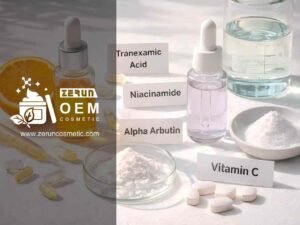
Vitamin C is one of the best-known options because it works as an antioxidant and also interferes with melanogenesis. The best-studied form for pigment work is L-ascorbic acid, often discussed in the 5% to 20% range, but it is also notoriously unstable and not always easy for sensitive skin to tolerate. That is why many formulas switch to derivatives even though derivatives do not all have the same depth of evidence.
Niacinamide deserves a different kind of attention. It is not the most dramatic “dark spot acid,” but it is one of the most practical serum ingredients because it reduces melanosome transfer, supports barrier function, and generally fits well into multi-active routines. That makes it especially useful when people want visible improvement without the downtime or sting they sometimes get from more aggressive formulas.
Alpha arbutin is popular because it targets tyrosinase and is often perceived as a gentler dark-spot ingredient than harsher depigmenting options. The research base is not as broad as for some prescription therapies, but reviews still place arbutin among relevant pigment-control ingredients, especially in cosmetic brightening systems.
Tranexamic acid has become one of the most interesting brightening serum ingredients for modern formulas. Recent reviews describe it as useful not only for pigmentation but also for inflammation-linked discoloration and barrier recovery, which helps explain why it shows up so often in serums for post-acne marks and melasma-prone skin. It is especially valuable when dark spots are not “quiet,” but tied to redness, repeated irritation, or persistent inflammatory triggers.
Azelaic acid sits in a very practical middle zone. It has antimelanogenic, anti-inflammatory, and antimicrobial value, so it makes sense for people dealing with acne and marks at the same time. Reviews continue to support its role in melasma and post-inflammatory hyperpigmentation, and it can be a smart choice when you do not want a serum that only chases pigment while ignoring the breakout cycle creating the marks.
Kojic acid is still a relevant pigment ingredient because of its tyrosinase-inhibiting activity, but in practice it is often better used as part of a broader formula than as the entire story. It can be effective, yet formulators also pay attention to stability and irritation potential, which is one reason supportive ingredients matter so much in brightening serums.
| Ingredient | Main Brightening Role | Best Fit | Watch-Out |
|---|---|---|---|
| Vitamin C | Antioxidant + helps reduce melanin formation | Dullness, photoaging, early uneven tone | Instability, sting, oxidation issues |
| Niacinamide | Helps reduce pigment transfer + supports barrier | Sensitive, oily, beginner-friendly routines | Usually slower and steadier, not dramatic overnight |
| Alpha Arbutin | Tyrosinase-related pigment control | Spot-focused brightening formulas | Often works best in blends |
| Tranexamic Acid | Helps with pigment, inflammation-linked discoloration, barrier recovery | Melasma-prone, post-acne marks, mixed discoloration | Usually needs consistency and sunscreen discipline |
| Azelaic Acid | Pigment control + anti-inflammatory + anti-acne | Acne marks, redness-prone, reactive skin | Can tingle or feel drying in some routines |
| Kojic Acid | Tyrosinase inhibition | Stubborn uneven tone in combination formulas | Stability and irritation can limit user comfort |
These are not interchangeable ingredients. They overlap, but they do not do the same job in the same way. That is the first big decision point when building or choosing a brightening serum. (PMC)

Which Brightening Serum Ingredients Work Best for Different Types of Discoloration?
One reason brightening serums fail is that “dark spots” is a loose phrase. A fresh post-pimple mark, a patch of melasma, and years of sun-related uneven tone do not respond exactly the same way. Matching ingredients to the type of discoloration gives you a much better chance of building a routine that makes sense.
Post-acne marks often sit at the intersection of pigment and inflammation. If breakouts are still active, using only a brightening serum can feel like mopping the floor while the tap is still running. This is where azelaic acid, niacinamide, and tranexamic acid make more sense than a formula built only around exfoliation. Acne and dark spots should often be treated together, and PIH commonly darkens further with sun exposure.
Melasma usually asks for more patience and better trigger control. It is not just a matter of “fading a leftover spot.” Sunlight and visible light can worsen it, especially in darker skin tones, which is why tinted sunscreen with iron oxide keeps coming up in dermatology guidance. For melasma-prone skin, ingredients like tranexamic acid, azelaic acid, niacinamide, and vitamin C can all play a role, but they work best in routines that take light protection seriously.
General dullness is different again. If skin looks flat rather than patchy, the issue may be oxidation, rough texture, dehydration, or slower shedding. In that case, vitamin C, mild exfoliants, retinoids, and barrier-friendly hydrators may matter more than piling on every pigment inhibitor in the market.
| Skin Concern | What Is Usually Going On | Ingredient Priorities | Practical Formula Direction |
|---|---|---|---|
| Post-acne marks | Pigment + inflammation + ongoing breakouts | Azelaic acid, niacinamide, tranexamic acid | Calm skin while fading marks |
| Melasma-prone uneven tone | Persistent pigment triggered by light and irritation | Tranexamic acid, azelaic acid, niacinamide, vitamin C | Gentle brightening plus strict sunscreen support |
| Sun-related uneven tone | Oxidative stress + pigment + photoaging | Vitamin C, niacinamide, retinoid support | Antioxidant-led routine |
| Rough, tired-looking dullness | Slow turnover + dehydration + texture buildup | Mild AHA, retinoid, humectants | Surface renewal without over-stripping |
| Sensitive reactive discoloration | Barrier disruption + inflammation | Niacinamide, azelaic acid, low-irritation support system | Lower-strength, longer-use strategy |
Dermatology guidance and review literature both point in the same direction: the best ingredient is often the one that matches the cause, not the one with the loudest marketing.
There is also a timing element people often miss. Fresh discoloration, especially after acne or irritation, usually behaves differently from older, more established pigment. Newer marks may respond well to calming, pigment-interrupting formulas. Older, duller, more stubborn tone problems may need a longer plan that combines pigment control with turnover support. That is why the same serum can feel brilliant for one user and underwhelming for another. The issue is not always the serum. Sometimes it is the stage of the discoloration.
Another common mismatch is trying to treat redness-linked marks with a formula built only for brown pigment, or trying to treat rough, congested, thickened skin with a serum that is all soothing and no renewal. Good brightening routines are often less about “more actives” and more about cleaner targeting. When the target is right, even a modest formula can look surprisingly effective over time.
Why Vitamin C Still Matters in Brightening Serums
Vitamin C gets talked about so often that people either overrate it or dismiss it. The truth sits in the middle. It is not the only brightening ingredient that matters, but it is still one of the most useful because it helps on several fronts at once: oxidative stress, uneven tone, and support for a fresher-looking complexion. That is why it remains a cornerstone in brightening serums despite formulation challenges. )
Where people get confused is assuming all vitamin C serums work the same. L-ascorbic acid is the most established form, but it is also the form most associated with oxidation and sting. A serum may look strong on the label and still disappoint if it oxidizes too fast, feels too harsh, or sits in packaging that does not protect the formula well. This is one reason formulators often choose derivatives such as 3-O-ethyl ascorbic acid, sodium ascorbyl phosphate, magnesium ascorbyl phosphate, or THD ascorbate when they want a more stable or skin-friendly system, even if the evidence base is not identical across all forms.
Vitamin C also works best when it is not forced to do every job alone. If the user’s main complaint is stubborn patchy pigment, vitamin C can be a valuable part of the formula, but pairing it with niacinamide, tranexamic acid, or arbutin often makes more practical sense than relying on an “ultra-high-strength C serum” that users quit after a week. Combination therapy keeps appearing in the literature because pigment problems usually have more than one driver.
From a product-development perspective, vitamin C is often best treated as the antioxidant lead in a brightening serum, not automatically the only hero. That small shift produces better formulas. Instead of asking, “How high can we push the vitamin C level?” the better question is, “What does this skin concern need vitamin C to do, and what other ingredients will help it do that job comfortably?” That is the difference between a serum people admire and a serum they actually finish.
A useful way to judge a brightening serum is to ask whether it solves only the color problem or also the conditions that keep creating the color problem. That is why formulas built around teamwork often hold up better than formulas built around one headline active.

Why Niacinamide, Tranexamic Acid, and Azelaic Acid Often Make a Better Team Than One Hero Ingredient
Niacinamide is valuable because it is low-drama. It helps regulate pigment transfer, supports the barrier, and works across many skin types. It may not feel as “active” as a strong acid, but that is exactly why formulators lean on it so often. A serum that reduces irritation risk has a better chance of being used long enough to show visible change.
Tranexamic acid adds a different strength. Recent literature describes benefits not only in hyperpigmentation but also in inflammation-linked redness and barrier recovery. That makes it a strong fit when the user’s skin seems to get darker every time it gets irritated. In other words, tranexamic acid is helpful when the discoloration story is messy rather than neat.
Azelaic acid then rounds out the picture. It can address pigment, help with blemish-prone skin, and support calmer-looking skin overall. For users who break out, flush easily, or develop marks after every inflammatory episode, azelaic acid can do work that pure dark-spot correctors cannot.
Put together, these three ingredients illustrate a useful product-design principle: a strong brightening serum does not always aim to be the most aggressive serum in the routine. Often it aims to be the serum most likely to survive real daily use. That is a more useful standard for customers and a smarter one for brands.
The combination logic is practical. Niacinamide helps steady the formula and broadens skin-type compatibility. Tranexamic acid addresses discoloration that is linked to inflammation and recurrent sensitivity. Azelaic acid adds help for blemish-prone or redness-prone users who do not just want a clearer-looking tone, but calmer-looking skin. When these are balanced well, the serum feels more complete. It is doing less “one big promise” marketing and more actual problem solving. (PubMed)
This kind of blend is also easier to position commercially. A one-note serum may sound strong, but a multi-pathway serum can be easier to adapt across channels. For DTC brands, it gives a more relatable story because consumers rarely describe their skin in one-word clinical terms. They say things like, “My skin looks dull after breakouts,” “My marks linger forever,” or “My tone is uneven and my skin is sensitive.” A formula that can answer those combined complaints usually has a better chance of repeat purchase. These formula directions are based on the same idea repeated across hyperpigmentation literature: results improve when more than one pathway is addressed, but irritation has to stay under control.
When Do Exfoliating Acids and Retinoids Make Sense?
Brightening is not only about suppressing pigment. Sometimes skin looks dull because old surface cells are hanging on too long, texture is rough, and the face reflects light poorly. That is when exfoliating acids and retinoids enter the conversation.
Alpha hydroxy acids such as glycolic acid and lactic acid help loosen surface buildup and can improve the look of rough, tired skin. Hydroxy acids have long been used in cosmetic and dermatologic formulations for exactly this reason. They can make skin look more radiant by improving turnover and texture, and they may also support fading of some superficial discoloration over time.
Retinoids matter because they influence epidermal turnover and have documented relevance in pigmentary disorders, including melasma and post-inflammatory hyperpigmentation. They are especially useful when dullness sits beside congestion, photoaging, or stubborn uneven texture.
But here is where many routines go wrong: people stack too many turnover-focused ingredients at once and then wonder why their dark spots look worse. Irritation can feed post-inflammatory hyperpigmentation, and dermatology guidance repeatedly warns that harsh exfoliation is a poor idea for darker skin tones or for people who already notice dark marks after acne, bites, or irritation. Even general anti-aging advice from dermatologists emphasizes starting slowly rather than using several strong actives at the same time. (美国皮肤病学会)
| Turnover Ingredient Type | What It Helps Most | Best For | Common Mistake |
|---|---|---|---|
| Mild AHA serum | Roughness, low glow, shallow uneven texture | Dry or dull skin that is not highly reactive | Using it too often with other exfoliants |
| Stronger AHA direction | More visible surface renewal | Thickened, resilient skin | Chasing fast results and triggering irritation |
| Retinoid-led serum | Texture, congestion, photoaging, longer-term tone refinement | Combination, acne-prone, mature skin | Pairing with too many harsh actives too soon |
| Exfoliation + pigment blend | Mixed dullness and discoloration | Experienced users with good barrier tolerance | Forgetting sunscreen and barrier support |
The simple rule is this: if the skin gets darker after irritation, you should be more conservative with exfoliation, not more aggressive.
Which Supporting Ingredients Make Brightening Serums Easier to Use Consistently?
This is the part many brightening-ingredient articles skip, and it is one of the biggest reasons formulas succeed or fail. Brightening serums are not judged only by actives. They are judged by whether skin can keep using them.
Hydrators such as glycerin and hyaluronic acid do not fade dark spots on their own in the way tranexamic acid or arbutin can, but they improve comfort, reduce the tight dry feeling that makes users abandon a product, and help a routine feel immediately rewarding while slower pigment ingredients do their work. A serum that gives no early comfort signal often gets blamed for “not working” before it has had time to work.
Barrier-support ingredients matter for another reason: irritated skin is harder to brighten. Dermatology guidance for melasma and dark spots repeatedly stresses gentle skin care because burning and stinging can worsen discoloration. That means formula architecture matters. Panthenol, soothing extracts, ceramide support, or a less stripping solvent system may not be the headline on the front of the bottle, but they often determine whether the headline ingredient stays in the user’s routine.
Good brightening serums also need the right texture and packaging. Vitamin C systems are especially sensitive to oxidation. Kojic acid and some acid systems can be less forgiving in unstable environments. Airless or light-protective packaging, a clean solvent system, and a non-greasy finish for oily skin are not side details. They are part of ingredient performance.
| Formula Layer | What It Does in a Brightening Serum | Ingredient Examples | Why It Matters |
|---|---|---|---|
| Lead brightening actives | Targets pigment pathways directly | Tranexamic acid, alpha arbutin, azelaic acid, vitamin C | Gives the serum its main correction job |
| Support brightening actives | Expands results without pushing irritation too hard | Niacinamide, gentle antioxidants, licorice-type support | Improves breadth and tolerance |
| Hydration system | Adds comfort and softens the treatment feel | Glycerin, hyaluronic acid, betaine | Encourages daily use |
| Barrier-calming system | Lowers the chance of rebound irritation | Panthenol, ceramide support, soothing agents | Important for reactive or PIH-prone skin |
| Delivery and packaging system | Protects ingredient integrity and user experience | Stable base, airless pack, light-protective bottle | Helps the serum stay effective over time |
For brands, this is where many winning products separate themselves. Consumers may search by hero ingredient, but they stay loyal to formulas that feel usable, stable, and calm on skin.

How Should You Choose Brightening Serum Ingredients by Skin Type, Skin Tone, and Tolerance?
A good brightening serum for one person can be a bad one for another. The gap is usually not intelligence or effort. It is mismatch.
Sensitive skin usually does better with gentler daily brightening rather than a high-pressure formula. Niacinamide, azelaic acid, arbutin, and carefully built vitamin C derivatives often make more sense than trying to jump straight into a very strong acid-heavy routine. This is especially true when skin already stings easily, because irritation itself can make discoloration harder to control.
Oily or acne-prone skin often needs ingredients that can address both the trigger and the mark. Azelaic acid, niacinamide, and retinoid-compatible systems are often more logical here than a formula built mainly around rich oils and antioxidants. If breakouts keep happening, the brightening plan has to work alongside blemish management.
Darker skin tones often need more caution with irritation and more discipline with light protection. PIH is more frequent and sometimes more intense in skin of colour, and visible light can worsen melasma and other dark spots. That makes gentle formulation, tinted sunscreen, and steady use especially important.
Dry skin, meanwhile, may misread dehydration as “pigment.” If the surface is rough and dehydrated, even a good brightening ingredient can look underwhelming because the skin is not reflecting light well. In those routines, hydration and a comfortable emulsion or serum base can make brightening results look better sooner, even before deep discoloration has fully faded.
There is also a routine-design side to this. People with sensitive skin usually do better when a brightening serum is the main active step, not one of four aggressive treatment steps layered together. People with oily or acne-prone skin often prefer textures that disappear quickly and do not leave a coated feel, which means formula aesthetics can influence compliance just as much as the ingredient list. People dealing with melasma-prone tone issues may get more benefit from a moderate-strength serum used faithfully with visible-light-conscious sunscreen than from a stronger serum used only on and off.
For brands, these differences affect product positioning. The same brightening ingredient stack can be turned into a watery serum for humid climates, a light emulsion for compromised barriers, or a more treatment-led night serum for users who want a stronger feel. “Best ingredients” is only part of the answer. “Best delivery style for the target buyer” is the rest of it.
The practical takeaway is simple. Do not choose the most famous brightening serum ingredients first. Choose the ingredients your skin can use consistently and the formula structure your skin can live with.
Another factor that changes results is routine placement. A brightening serum does not have to be the most complicated product in the routine, but it does need the right support around it. In most cases, that means gentle cleansing, disciplined sunscreen use, and not changing the whole routine every few days. Dermatology guidance on dark spots keeps returning to sunscreen because progress is hard to see when light exposure keeps pushing pigment back up. For many people, especially those dealing with melasma or persistent PIH, a tinted sunscreen with iron oxide is not a small extra. It is part of the brightening strategy itself.
It also helps to separate “feeling active” from “being effective.” Serums that sting, peel aggressively, or leave skin hot and tight often get interpreted as stronger. In pigment-prone skin, that can be the exact opposite of what you want. Burning and stinging are not signs that dark spots are being erased. They may be signs that the barrier is being pushed too far. This is one reason so many people see better long-term results from moderate formulas they can use every day than from strong formulas they keep stopping and restarting.
A smart brightening routine usually keeps one main correction serum, then builds around it. If the serum is antioxidant-led, the rest of the routine should avoid making skin unnecessarily reactive. If the serum is acid-led or retinoid-led, the rest of the routine often needs more cushioning. When the routine is balanced, the user notices not only brighter-looking tone over time, but also fewer setbacks from dryness, flaking, or rebound irritation. That balance is less flashy than a “15 active ingredients” label, but it is often what makes a formula commercially successful.
What Does a Strong Brightening Serum Formula Look Like?
From a formulator’s point of view, the strongest brightening serum is rarely the one with the longest ingredient story. It is the one with a clear job, a sensible active stack, and a texture people want to reach for every day.
A serum aimed at post-acne marks may be built around azelaic acid or tranexamic acid, with niacinamide as a steady support ingredient and a calm, light texture that oily skin accepts. A serum for city dullness and early uneven tone may be antioxidant-led, with vitamin C or a derivative supported by niacinamide and humectants. A serum for reactive, pigmentation-prone skin may deliberately avoid overloading acids and instead rely on a slower but more comfortable mix of arbutin, niacinamide, and barrier support. These directions fit what the literature shows about multi-pathway management and the importance of tolerability.
That is also why “best brightening ingredient” is the wrong question for brands developing a serum. The better questions are: Which type of discoloration are we targeting? How fast do we want the formula to feel active? How much tolerance does the target user have? What texture will they actually enjoy? And does the packaging protect the ingredient system we chose? Those decisions shape product success more than chasing one trendy active.
A strong serum brief usually includes five things. First, define the main discoloration lane: post-acne marks, melasma-prone uneven tone, general dullness, or mixed concerns. Second, decide whether the serum is pigment-led, antioxidant-led, or texture-led. Third, set the barrier strategy so the active system is actually wearable. Fourth, match the texture to climate and channel; a premium-looking brightening serum for a prestige line may not be built the same way as a quick-absorbing serum for oily-skin DTC buyers. Fifth, protect the formula with packaging that suits the ingredient system. Vitamin C-heavy formulas especially should not be treated casually on this point. (PMC)
| Target Formula Goal | Active Stack Idea | Support System | Best Positioning Angle |
|---|---|---|---|
| Dark-spot correction for daily use | Tranexamic acid + niacinamide + alpha arbutin | Glycerin, panthenol, light barrier support | “Even tone without over-stripping” |
| Brightening for acne-prone skin | Azelaic acid + niacinamide + calming support | Light humectants, non-heavy finish | “Helps with marks and breakout-prone skin” |
| Antioxidant radiance serum | Vitamin C or derivative + niacinamide | Humectants, elegant finish, protective pack | “Glow and tone refinement” |
| Sensitive-skin tone serum | Arbutin + niacinamide + soothing system | Barrier-friendly base, low-irritation profile | “Gentle daily brightening” |
| Night renewal brightening serum | Retinoid or mild acid support + pigment helpers | Cushioning emulsion, recovery support | “Tone and texture reset” |
This kind of matrix is far more useful in development than arguing endlessly about one hero ingredient. It lets a brand build around a clear user need, and it reduces the risk of making a serum that sounds impressive but feels confusing in actual use.
There is also a communication advantage. Consumers searching for brightening serum ingredients are often not searching like formulators. They may type “best serum for acne marks,” “serum for dull skin,” or “what ingredients brighten uneven skin tone.” A good product therefore needs an ingredient story that is technically coherent and consumer-readable at the same time. That usually means one leading promise, two or three support ideas, and a texture claim that matches the experience.
For example, a brand might technically build a serum around niacinamide, tranexamic acid, and arbutin, but what the buyer remembers is that the serum is lightweight, does not pill under sunscreen, helps fade old blemish marks, and does not make the skin feel raw. That is not shallow marketing. That is the commercial translation of smart formulation.
The same principle matters for packaging and channel planning. A brightening serum sold through Amazon may need a clearer, faster benefit story and a formula aesthetic that reads well in reviews within the first few weeks. A prestige clinic or spa channel may accept a more treatment-led feel if the texture, claims, and visual positioning communicate expertise. A custom manufacturer has to think beyond the INCI list and ask how the same active stack will live in different sales environments.
In that sense, the best brightening serum ingredients are not just the ones that look impressive in a lab brief. They are the ones that can be turned into a stable, comfortable, easy-to-position product for the target user. That is why product development around brightening serums works best when actives, texture, packaging, and buyer language are planned together.

Conclusion
Brightening serum ingredients do not all work in the same way, and that is exactly why this category deserves a more careful look. Vitamin C helps when oxidation and uneven tone are part of the problem. Niacinamide supports brighter-looking skin in a steady, barrier-friendly way. Tranexamic acid is especially useful when discoloration overlaps with inflammation. Azelaic acid earns its place when blemishes and marks show up together. Arbutin and kojic acid remain relevant for pigment control, while exfoliating acids and retinoids make more sense when dullness is tied to slow turnover and rough texture. Across all of these options, one principle stays the same: the best brightening serum is not the one with the most aggressive label. It is the one that matches the cause of discoloration, protects the barrier, and is comfortable enough to use consistently with sunscreen. If your brand is planning a custom brightening serum, contact Zerun Cosmetic to develop a formula, texture, active stack, and packaging direction that fits your target market and channel.