Skip to content
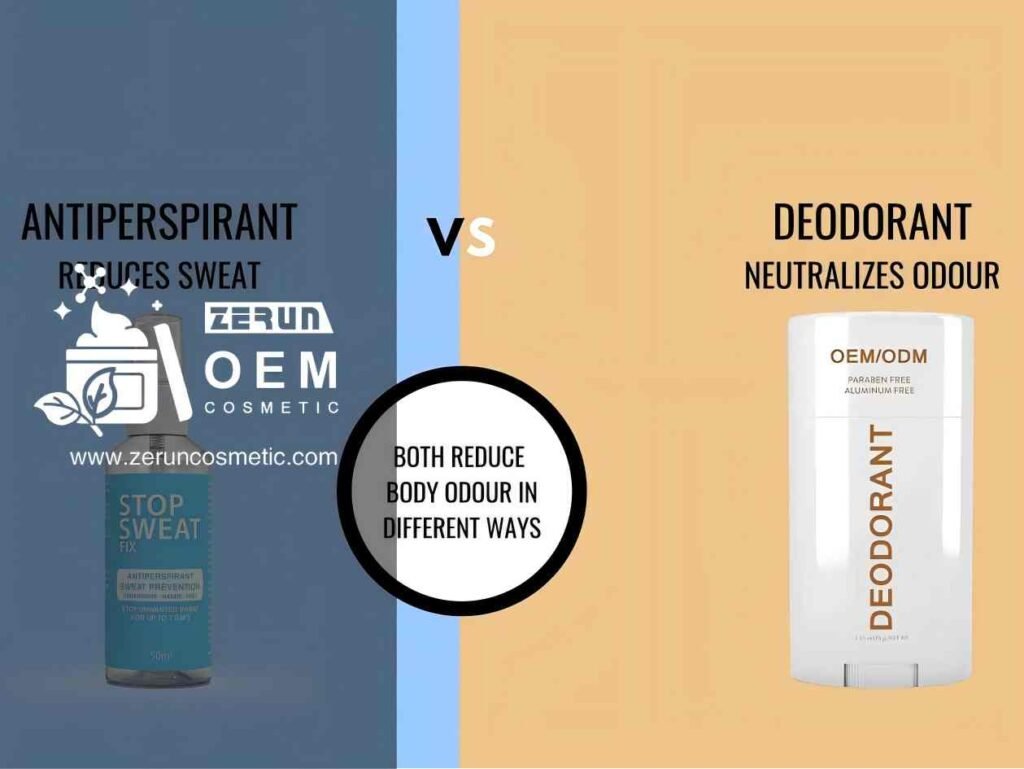
Buying underarm care shouldn’t feel like trial-and-error—yet it often does. Many people pick a product that solves the wrong problem: wetness (visible sweat, damp shirts, discomfort) versus odor (smell that shows up after stress, heat, or workouts).
Antiperspirant is the better choice when wetness is the main complaint, because it’s designed to reduce sweating at the application site. Deodorant is the better choice when odor is the main complaint, because it’s designed to control smell (often by addressing odor-causing bacteria and scent perception). The “best” option depends on four practical factors—sweat level, odor profile, skin sensitivity, and preferred format (gel deodorant, deodorant spray, stick, roll-on, or travel size). For brands building private label lines, the product-format and performance trade-offs are mapped in the custom deodorant formulations resource.
What’s the difference between antiperspirant and deodorant?
In plain terms: antiperspirant targets sweat, while deodorant targets odor. Confusion happens because many products combine both functions and the label language blends them together.
| Feature | Deodorant | Antiperspirant |
|---|---|---|
| Primary goal | Reduce odor | Reduce wetness (sweat) |
| What it targets | Odor formation on the skin (often linked to bacteria + scent profile) | Sweat output at the application site |
| What “success” feels like | You smell fresher later | Underarms feel drier; fewer damp marks |
| Typical formats | Stick, roll-on, gel, cream, wipes, sprays | Stick, roll-on, gel, cream, sprays (OTC drug formats) |
| When it’s the better pick | “Odor is the issue” | “Wetness is the issue” |
A quick diagnostic that prevents most bad purchases:
- “I feel damp / I show sweat marks.” → antiperspirant usually makes more sense first.
- “I’m not that wet, but I smell fast.” → deodorant usually makes more sense first.
That same logic holds when comparing popular subtypes like best men’s deodorant, best natural deodorant, or best aluminum free deodorant—they’re still solving either odor, wetness, or a compromise between the two.
How do antiperspirants and deodorants work (sweat control vs odor control)?

Sweat and odor often show up together, but they’re not the same problem—and treating them as the same leads to disappointing results.
Why odor happens?
Underarm odor usually comes from what happens after sweating: microbes on the skin break down sweat components and create smelly byproducts. Deodorants aim to reduce odor by disrupting that pathway—commonly by lowering odor formation on the skin surface, shifting the scent experience, and improving how the product wears through the day.
That’s why “best deodorant for men” searches frequently correlate with situations where odor performance matters more than dryness: heat, stress, workouts, long commutes, and long meeting days.
Why wetness happens ?
Antiperspirants are designed to reduce perspiration at the application site. In FDA language, an antiperspirant is a topical drug product intended to reduce the production of perspiration (sweat).
This explains two common frustrations:
- “It smells fine, but I’m still drenched.” → odor control was addressed; wetness wasn’t.
- “I’m drier, but I still smell off later.” → wetness improved; odor pathway still needs stronger control.
Format choice (gel deodorant vs deodorant spray vs stick) then becomes a comfort and routine decision—dry-down speed, residue, sensitivity, and reapplication habits.
Are antiperspirants regulated differently from deodorants in the US?
Yes—and the difference is one reason labels, actives, and claims look so different across products.
- Deodorants are generally treated as cosmetics (FDA’s cosmetic product categories include underarm deodorants across common formats).
- Antiperspirants are regulated as OTC drug products under an FDA OTC monograph framework (and related CFR sections), because they are intended to reduce sweating.
It’s also common to see combined products marketed as antiperspirant-deodorants; FDA notes examples of products that can fall into both cosmetic and drug categories, including antiperspirant-deodorants.
Practical implication: when wetness control is part of the promise, the product pathway and substantiation mindset is different than an odor-only deodorant—especially relevant for brands trying to balance performance, claims, sensitivity, and launch speed.
Which is better for you?
Most “antiperspirant vs deodorant” confusion disappears once the main complaint is named. Underarm problems usually fall into one of three buckets—wetness, odor, or irritation—and each bucket points to a different “best” choice.
Path A: Wetness is the main issue (you feel damp or see sweat marks).
Antiperspirant is usually the better first step because it’s designed to reduce sweating at the application site. Dermatologists commonly summarize it as: antiperspirants help reduce sweating; deodorants don’t.
Helpful reality-checks:
- If the shirt is damp but odor isn’t strong, odor-focused products often feel “useless” simply because they weren’t meant to stop sweat.
- If sweating is heavy (stress sweat, hot climate, high-output workouts), performance expectations should be set around “less wet,” not “zero sweat.”
Path B: Odor is the main issue (you smell fast, even if you’re not very wet).
Deodorant is often the better fit because odor is usually driven by what happens on the skin surface after sweating—microbes and odor formation—not the sweat itself.
This path is where searches like best deodorant for men, best men’s deodorant, good deodorant for men, and best guy deodorant tend to land: odor control, long-wear scent, and “clean dry-down” matter more than maximal dryness.
Path C: Sensitivity is the main issue (sting, itch, redness, peeling, burning after shaving).
Here, “best” usually means the least irritating option that still meets the odor/wetness goal. Two common traps:
- Choosing a strong “natural” formula that uses high-pH odor fighters (can irritate easily—more on that below).
- Over-layering multiple products (fragrance + acids + friction + shaving) and blaming the last one applied.
A practical way to avoid wasted trials: pick one priority (wetness vs odor), pick one format that fits the routine (stick/roll-on/gel/spray), then only adjust one variable at a time (scent strength, sensitive-skin positioning, or aluminum-free).
What makes the best deodorant for men different?
When people search best deodorant for men or best men’s deodorant, they’re rarely asking for a “universal winner.” They’re trying to solve one (or more) of these real-life situations:
1) Heat + stress days (odor spikes even without extreme workouts).
The “best” pick here usually means odor control that survives:
- long commutes,
- crowded indoor spaces,
- and stress sweat (often more noticeable in smell).
2) Training days (odor + reapplication habits).
Gym routines reward deodorants that:
- don’t turn sticky when layered,
- don’t leave heavy residue that traps odor over time,
- and stay pleasant after repeated reapplication.
3) Office wear (white marks, yellow stains, and scent etiquette).
The “good deodorant for men” decision often comes down to finish and wear:
- low residue,
- less transfer onto dark fabrics,
- and a scent profile that doesn’t feel overpowering at close distance.
4) Skin + hair factors (friction and trapped odor).
Underarm hair, tight athletic fabrics, and shaving frequency all change what “best guy deodorant” means. More friction and occlusion can amplify irritation and odor persistence, so the best choice may be the one that reduces rubbing and dries down cleanly.
A simple selection rule that helps both consumers and brand teams:
- If odor is the #1 complaint, prioritize odor performance + comfortable dry-down, then choose scent intensity (fresh/clean vs bold/fragrance-led) to match the channel and audience.
- If wetness is the #1 complaint, switching categories (deodorant → antiperspirant) often changes results faster than switching brands within the same category.
What is the best natural deodorant?

Search intent behind best natural deodorant is usually a mix of goals: “cleaner-feeling,” “less irritating,” “less residue,” or “aluminum-free.” The catch is that “natural” isn’t one formula style—there are several approaches, and they behave differently.
Why natural deodorant can feel like it “stops working”
Three patterns explain most early disappointment:
- Expectation mismatch (odor vs wetness). Natural deodorants can be great at odor control, but they generally don’t stop sweating the way antiperspirants do. If “dryness” is the goal, natural deodorant may feel like a downgrade even when it’s performing normally.
- Application pattern mismatch. Many people apply like an antiperspirant (one pass and forget), but odor-control products often perform best with even coverage and routine-aware reapplication (especially on workout days).
- Irritation masquerading as “failure.” If the underarm barrier gets irritated, rubbing and inflammation can make odor feel worse and make any product sting—so it gets labeled “doesn’t work,” when the real problem is tolerance.
A common “natural” irritant to know about: baking soda
Baking soda shows up frequently in natural deodorants because it can reduce odor, but it’s also much more alkaline than skin and can disrupt the skin’s normal pH—leading to dryness, redness, itching, and irritation in some people.
That’s why many “best natural deodorant” wins are really best-for-your-skin wins: the formula that stays comfortable is the formula that stays usable.
Natural deodorant tends to work best when the goal is odor control with a lighter feel, and when the formula and scent intensity match the user’s sensitivity and reapplication habits.
What is the best aluminum free deodorant if you still sweat a lot?
“Best aluminum free deodorant” is often searched by people who want to avoid aluminum-based antiperspirant actives but still need reliable day-long freshness. The key is knowing what aluminum-free can and can’t do.
Aluminum-free usually means: odor control without sweat blocking.
Antiperspirants reduce sweating; deodorants don’t.
So if sweating is heavy, aluminum-free deodorant can still be a great choice—but expectations should be set around:
- smelling fresher longer,
- feeling cleaner through the day,
- and staying comfortable with reapplication, rather than eliminating wetness.
How to choose aluminum-free when sweat is heavy
- If sweat marks are the biggest frustration, consider whether the real goal is “less wet” versus “less smell.” If it’s truly wetness, an antiperspirant category choice is the more direct lever.
- If odor is the bigger frustration, aluminum-free can work well—especially when the formula is comfortable enough to reapply without irritation and residue buildup.
Sensitivity matters more in aluminum-free searches than many expect.
A lot of aluminum-free disappointment comes from irritation, not performance. When the underarm skin is inflamed, almost anything will sting, and odor can feel amplified by friction and stress sweat. That’s why “best aluminum free deodorant” often ends up meaning: the one that stays wearable every day.
For anyone weighing safety concerns around aluminum, a deeper discussion of common questions is covered here: Is aluminum in deodorant harmful?
What is gel deodorant and when does it beat sticks and creams?
Gel deodorant is usually chosen for one reason: a cleaner, lighter feel with less visible residue. The best versions dry down smoothly and leave the underarm feeling “bare,” which is exactly why gel is often favored by people who wear dark shirts, train frequently, or dislike that waxy buildup some sticks can leave.
Gel tends to win when:
- Residue and transfer are the biggest annoyance (white streaks, product catching on hair, buildup on fabric).
- Dry-down feel matters more than maximum “cushion” (many creams feel soothing, but can stay tacky).
- Reapplication is part of the routine (gel layers more comfortably when it’s truly quick-drying).
Where gel can disappoint:
- Some gels feel wet for too long in humid climates or on very sweaty days.
- If the formula leans heavily on fragrance, it can feel strong at close range—fine for some men’s routines, too much for others.
- Sensitive underarms may react to certain odor-control approaches regardless of format, so “gel” isn’t automatically “gentle.”
A practical selection rule: if the goal is odor control with a cleaner finish, gel is often the easiest upgrade. If the goal is maximum wetness reduction, switching categories (to antiperspirant) usually moves the needle faster than switching formats.
Is deodorant spray worth it? Gel vs spray vs stick for real-life routines

Deodorant spray is often “worth it” when speed, even coverage, and easy touch-ups matter. It’s popular for gym bags, hot climates, and people who dislike the feeling of product dragging on the skin. It’s also common for men who want a lighter feel but still want confident odor control through the day.
A quick way to choose between formats:
| Format | When it’s a strong choice | Common trade-offs |
|---|---|---|
| Spray | Fast, light feel, easy reapply, even coverage | Mist cloud (breathing/overspray), fragrance can feel stronger, may miss exact placement |
| Gel | Clean finish, lower visible residue, comfortable layering | Can feel slow to dry in humidity; some feel slick if overapplied |
| Stick | Familiar, controlled placement, strong “stays put” feel | Residue/transfer, buildup over time, visible marks on dark fabrics |
Two spray realities that save a lot of frustration:
- Spray is not one thing. Some sprays are aerosol and some are pump/mist. The feel, dry-down, and packaging requirements can differ a lot.
- Technique matters. Many “spray doesn’t work” complaints come from spraying too far away (uneven coverage) or too close (wet spots and strong scent concentration).
For brands planning a spray line, the product-format pathways and technical considerations sit under the broader deodorant development map and the spray product architecture: Private Label Deodorant Spray and Private label aerosol deodorant spray: how can brands design a compliant propellant system?
How to choose a travel size deodorant without leaks or TSA surprises?
Travel size deodorant works best when it’s treated as a use-case product, not just a smaller bottle. Travelers are usually solving one of these: quick refresh after flights, odor control between meetings, gym-to-dinner transitions, or keeping a backup in a carry-on.
What makes a travel size actually travel-friendly:
- Cap security and lock design: a cap that won’t pop off in a bag matters more than the label promise.
- Leak resistance: pressure changes, heat in a car, and bag compression expose weak seals fast.
- Mess-free reapplication: travel products get used in bathrooms, taxis, and locker rooms—clean application is the real “premium.”
- Scent strategy: lighter scents tend to be safer for tight spaces (planes, elevators), while stronger “men’s” profiles often fit outdoor or gym travel better.
Format-specific travel guidance:
- If the routine needs fast refresh, spray is convenient but demands better overcap and nozzle protection.
- If leaks are the #1 worry, solid stick formats often feel simplest.
- If residue is the #1 worry (dark clothing, travel suits), gel can be a smart middle ground—if it dries quickly enough in the local climate.
For brands building minis, gift sets, or sampling kits around deodorant spray, packaging and SKU strategy considerations are covered here: Private label travel-size deodorant spray: how can brands win with minis, gift sets and sampling strategy?
What are Old Spice, Saltair, and Tone deodorant?
Brand-name searches usually reveal what the shopper actually cares about, even when they can’t describe it clearly.
Old Spice antiperspirant & deodorant searches often signal:
- a preference for classic men’s grooming positioning and bold scent identity,
- and a desire for sweat + odor protection in one purchase, since the brand sells both antiperspirant and deodorant lines and explicitly frames the “deodorant vs antiperspirant” decision for shoppers.
Saltair deodorant searches tend to signal:
- interest in skincare-led underarm care (acids, smoothing/brightening cues),
- and “clean” positioning such as aluminum-free and often baking soda–free messaging, which is especially attractive to sensitive-skin shoppers.
Tone deodorant searches tend to signal:
- a desire for soft skin feel + scent experience,
- and “clean-ish” comfort claims (often framed around no aluminum and dermatologist testing), which appeals to shoppers who want odor control without the harsher feel they associate with traditional sticks.
The practical takeaway: brand-term keywords are rarely about “the best overall.” They’re about a route—scent-led masculinity, skincare deodorant, or comfort-first clean positioning—and those routes map cleanly to product format and claim choices.
How should brands brief an OEM for deodorant vs antiperspirant?
A strong brief prevents most downstream rework because it aligns goal → format → claim boundaries → packaging reality from day one.
1) Define the primary job (pick one): wetness control or odor control
- If the promise includes reduced sweating, the product is stepping into antiperspirant territory and needs a different substantiation and compliance mindset than an odor-only deodorant.
- If the promise is freshness/odor control, the product can stay focused on deodorant performance and user experience.
2) Choose format based on the user’s “pain,” not trends
- Stick: controlled placement; can feel “strong and dependable,” but must manage residue and fabric transfer.
- Gel deodorant: clean finish and lower visible marks; must manage dry-down in humidity.
- Deodorant spray: fast refresh and light feel; packaging/nozzle protection and overspray experience become part of the product.
3) Write claims like a shopper speaks—but with measurable anchors
Good briefs tie claims to observable outcomes:
- “All-day freshness” → define the wear window and reapplication expectations.
- “Sensitive” → define what “sensitive” means (post-shave sting, fragrance tolerance, baking soda avoidance, etc.).
- “Aluminum-free” → clarify that it targets odor control, not sweat blocking.
4) Lock packaging constraints early (because they shape formula reality)
- Overcap design, seal integrity, and material compatibility decide whether travel size stays leak-free.
- For sprays, nozzle choice and propellant/pump architecture can reshape dry-down and perceived strength.
Frequently Asked Questions about Antiperspirant vs Deodorant
Shoppers often ask the same practical questions because underarm care failures feel personal—when the real issue is usually a mismatch between goal, format, and skin tolerance. These answers focus on fixes that work in real routines.
- Can deodorant stop sweating? Deodorant is primarily for odor control. If the main frustration is wetness (damp shirts, visible sweat marks), antiperspirant is typically the more direct solution because it’s designed to reduce sweating at the application site.
- Why does natural deodorant “stop working” after a week or two? The most common reasons are expectation mismatch (odor vs wetness), inconsistent coverage, and irritation. If the skin becomes inflamed (often from friction, shaving, or a high-pH ingredient like baking soda), odor can feel worse and any product can sting—making it seem like performance dropped.
- Is gel deodorant better than stick? Gel often feels cleaner with less visible residue, which helps with dark clothing and reapplication comfort. Stick formats often feel more “stays put.” The better choice depends on whether the priority is clean finish and low transfer (gel) or controlled placement and a heavier-duty feel (stick).
- Is deodorant spray better for men? Spray is popular in men’s routines because it’s fast, light, and easy to touch up. It’s a strong option for gym bags and hot climates. The downsides are overspray and scent intensity in tight spaces, so it works best when the spray pattern, dry-down speed, and fragrance strength match the daily environment.
- How can white marks and yellow stains be reduced? First, avoid overapplying—buildup is a big driver of transfer. Second, choose formats that match clothing: gel and some sprays tend to leave fewer visible streaks than heavier sticks. Third, let products dry before dressing, especially in humidity.
- What’s the safest approach for sensitive underarms? Reduce variables: lighter fragrance, fewer high-irritation odor fighters, and lower friction. After shaving, give the skin time to calm before applying strong formulas. If “sensitive” is the main issue, the most usable product is often the one that stays comfortable every day—because consistent use is what delivers consistent odor control.
Conclusion
The fastest way to choose between antiperspirant vs deodorant is to name the real problem first: wetness or odor. Antiperspirant fits routines where dampness and sweat marks are the main frustration, while deodorant fits routines where smell shows up quickly—especially under heat, stress, or workouts. From there, format decisions become clearer: gel deodorant often wins for a cleaner finish and lower residue, deodorant spray often wins for speed and easy touch-ups, and travel size deodorant works best when the cap, seal, and reapplication experience are designed for bags and tight spaces. Brand-term searches like Old Spice, Saltair deodorant, and Tone deodorant are rarely about a universal “best”—they usually signal a preferred route: bold scent + protection, skincare deodorant, or comfort-first clean positioning. When every choice maps back to goal, tolerance, and routine, underarm care stops being trial-and-error.