Skip to content
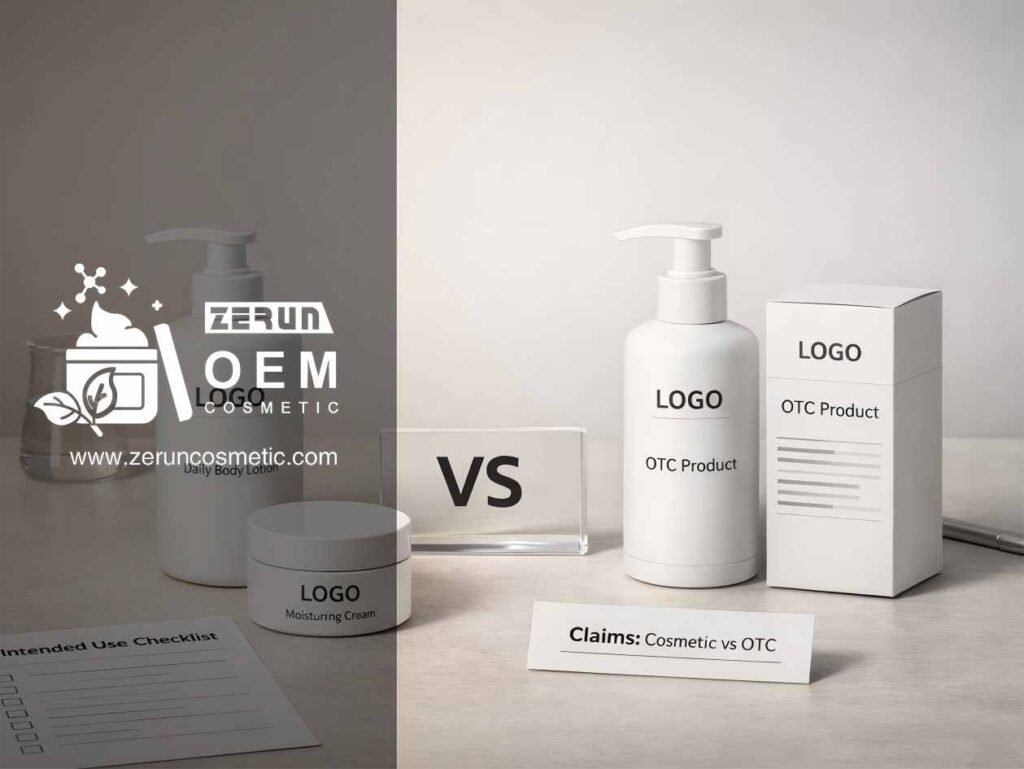
Most “OTC surprises” don’t come from your formula—they come from your claims. Brands often build a great product, print packaging, start ads, then discover their positioning quietly crossed into drug/OTC territory, forcing a costly rewrite of labels, listings, and timelines.
In the US, whether a product is regulated as a cosmetic or a drug/OTC is determined mainly by intended use—what your labeling, website, ads, and overall marketing imply the product is meant to do. If you claim to treat or prevent disease or affect the structure or function of the body, you may trigger drug/OTC requirements (and sometimes the product becomes both). See FDA: Is it a cosmetic, a drug, or both?.
In this guide, we’ll show the fastest way to self-check OTC risk before you brief your OEM—especially for sunscreen, deodorant/antiperspirant, acne, dandruff, and hair regrowth-adjacent products.
Cosmetic or OTC—who decides?
In the US, it’s not your supplier’s opinion or your Amazon category that decides—it’s your intended use. FDA looks at what you say the product does across the label, packaging, website, ads, and FAQs. If your messaging implies disease treatment or body-function changes, you may trigger drug/OTC rules (or become a cosmetic + drug combination). Start here: How can I tell if my product is a cosmetic, a drug, or both?.
What “intended use” evidence can include :
- Front label claims + directions (“use twice daily for 30 days”)
- Product detail pages, landing pages, blog posts, before/after images
- Ad copy, influencer scripts, customer service responses
OEM tip: If you’re developing hair-loss-adjacent products, align claims early with your positioning plan and supporting documentation (example resource hub: Custom Anti-Hair Loss Formulations).
The 7 OTC triggers brands miss

The fastest OTC risk check is to scan for “drug-like intent signals.” Most brands don’t get flagged because of one word—they get flagged because multiple signals stack: claim wording + symptom language + dosage-style directions + medical framing.
7 common triggers to self-check:
- Treat / cure / prevent / heal language (or close synonyms)
- Disease/symptom framing (e.g., “eczema,” “dermatitis,” “infection”)
- Body-function claims (“stop sweating,” “regrow hair”)
- Dosage/therapy cues (“course,” “clinically proven regrowth,” “X days to results”)
- “Medical-grade” positioning and prescription-style tone
- Before/after that implies treatment outcomes
- Channel/context cues (pharmacy/clinic treatment narrative)
Where brands often stumble first: deodorant positioning. If your concept touches sweat reduction, map the risk before packaging work (related OEM capability pages: Custom Deodorant Formulations and Private Label Deodorant Spray).
Table 1 — OTC Trigger Checklist (7 Signals)
| Trigger Signal | What It Looks Like in Real Copy | Risk Level | Safer Cosmetic-Side Direction |
|---|---|---|---|
| 1) Treatment / prevention verbs | “treats”, “cures”, “prevents”, “heals”, “mitigates”, “diagnoses” | High | Shift to “helps improve the look of…”, “helps reduce the appearance of…” |
| 2) Disease or condition terms | “acne”, “dandruff”, “eczema”, “psoriasis”, “dermatitis”, “infection” | High | Remove disease terms; use appearance language (e.g., “blemishes”, “visible flakes”) |
| 3) Body structure/function promises | “stops sweating”, “hair regrowth”, “kills bacteria”, “anti-inflammatory” | High | Focus on comfort/appearance (“fresh feel”, “clean feel”, “balanced-looking scalp”) |
| 4) Therapy / dosage framing | “dose”, “course”, “7-day treatment”, “use for 30 days”, “clinical regimen” | Medium–High | Write routine use (daily/weekly) without “treatment course” positioning |
| 5) Clinical/prescription vibe | “medical-grade”, “doctor strength”, “prescription-level results” | Medium–High | Use process credibility: “R&D-developed”, “stability-tested”, “quality-controlled” |
| 6) Before/after implying cure | Dramatic “condition → cure” transformations | Medium–High | If used, keep it subtle and “appearance-focused” (avoid disease framing) |
| 7) Category traps (US) | SPF/broad spectrum; sweat reduction; explicit acne treatment claims | High | Decide lane early: cosmetic-safe positioning vs OTC-ready pathway planning |
Which words flip you into “drug claims”?

A “cosmetic-safe” claim focuses on appearance, feel, or cleansing. A “drug claim” implies treating disease or changing body structure/function. The safest move is to rewrite outcomes into “supports / helps reduce the appearance of / improves the look of,” and remove disease terms entirely. FDA’s baseline explanation is here: Is it a cosmetic, a drug, or both?.
Red-flag claim patterns (high risk):
- “Treats acne / cures dandruff / kills bacteria / anti-inflammatory”
- “Stops sweating / blocks sweat glands”
- “Regrows hair / reverses hair loss”
Safer positioning patterns (usually lower risk):
- “Helps reduce the appearance of blemishes”
- “Supports a balanced-looking scalp”
- “Helps minimize odor” (vs “stops sweating”)
If you’re navigating Minoxidil-adjacent language: use a clear boundary strategy early (see: Minoxidil vs Biotin—Legally Claim).
Table 2 — Red-Flag Claims → Safer Alternatives (Copy-Ready Swap)
| If You Write This (Higher Risk) | Better Cosmetic-Safer Alternative | Why It’s Safer |
|---|---|---|
| “Treats acne” | “Helps reduce the appearance of blemishes” | Avoids disease treatment promise |
| “Cures breakouts” | “Helps keep skin looking clear” | Shifts to appearance outcome |
| “Kills acne bacteria” | “Helps keep skin feeling fresh and clean” | Avoids “antibacterial” treatment framing |
| “Anti-inflammatory” | “Helps calm the look of redness” | Keeps it appearance-focused |
| “Heals damaged skin” | “Supports a healthy-looking skin barrier” | Avoids medical healing claim |
| “Stops sweating for 72 hours” | “Helps minimize odor and keep underarms feeling dry” | Avoids sweat reduction promise |
| “Blocks sweat glands” | “Long-lasting freshness and odor control” | Avoids body-function claim |
| “Regrows hair” | “Supports the look of fuller, thicker hair” | Avoids regrowth claim |
| “Reverses hair loss” | “Helps improve the appearance of density” | Avoids treatment implication |
| “Treats dandruff” | “Helps reduce the look of visible flakes” | Avoids disease/condition treatment |
| “Treats scalp dermatitis” | “Helps soothe scalp discomfort” | Avoids medical condition claim |
| “Prevents infection” | “Helps cleanse and protect the skin’s comfort” | Avoids disease prevention claim |
If you say SPF in the US, are you automatically OTC?
Yes—SPF and broad-spectrum sun protection claims are treated as OTC drug territory in the US. That means your “SPF moisturizer,” “SPF stick,” or “SPF spray” isn’t just a cosmetic positioning choice; it can change your label structure, claim rules, and launch timeline. If SPF is part of your hero message, plan the project like a regulated pathway from day one.
Why SPF is a common “surprise OTC” trap
- “It’s just skincare + SPF” is not how the US system sees it. If you market sun protection, you inherit sunscreen-drug style expectations.
- Your artwork gets constrained. Layout, required statements, and “how to use” sections can eat label space and force packaging changes.
- Your ad copy becomes narrower. The more you promise medical outcomes (“prevents skin cancer,” “treats melasma”), the more risk stacks on top of an already high-regulation category.
Cosmetic-safe vs OTC-ready framing (how smart brands write)
- Cosmetic-safe angle: hydration feel, elegance, non-greasy wear, makeup compatibility (but do not imply disease prevention).
- OTC-ready angle: sun protection performance and usage directions are central, and the label is designed around compliance first.
OEM planning tip
If your target market includes the US, lock these decisions before sampling: packaging format, label real estate, and claim architecture. This prevents the “SPF is easy” trap that causes rework later. If you’re building a sunscreen line, start from an OTC-ready scope and then optimize sensorial feel within the compliant frame: Private Label Sunscreen Manufacturer.
(For internal compliance reference, keep this FDA sunscreen hub bookmarked: https://www.fda.gov/drugs/understanding-over-counter-medicines/sunscreen-how-help-protect-your-skin-sun)
Deodorant vs antiperspirant—why does one often stay cosmetic and the other goes OTC?
Deodorant is usually framed around odor control (a cosmetic-style promise), while antiperspirant is about reducing sweat (a body-function change). In the US, sweat reduction is the classic point where drug/OTC expectations show up—so brands must decide early whether they want “freshness management” or “sweat control” as the main selling promise.
Where brands accidentally cross the line
- They launch a “deodorant” but write copy like:
- “Stops sweating,” “blocks sweat glands,” “sweat-proof for 72 hours”
- They mix odor + sweat claims on the front label and ads, then wonder why compliance requirements escalate.
- They present dosing-style directions (“apply twice daily for a 14-day sweat reset”), adding a therapy vibe.
How to keep positioning clean (without losing conversion)
- If you want to stay closer to cosmetic positioning:
- Focus on odor-neutralizing strategy, fragrance architecture, dry-down feel, residue control, and skin comfort.
- Use “keeps you feeling fresh” and “helps neutralize odor” style language.
- If sweat reduction is truly the hero:
- Treat it as a different product roadmap: label layout, claims, and documentation planning come first.
OEM planning tip
Deodorant projects often win or lose on sensory + packaging architecture (spray, roll-on, stick, refill). Decide your “odor-only” vs “sweat-reduction” lane first—then we can design texture, fragrance, and packaging to match that lane without rework. If you’re building a deodorant range, this is the most relevant starting point for the manufacturing brief: Custom Deodorant Formulations.
The 3 categories brands most often “accidentally” turn into OTC: acne, dandruff, hair regrowth
If your product concept touches acne, dandruff, or hair regrowth, you’re in a high-risk zone for unintended OTC triggers—because the consumer expectation is “treatment,” and your copy naturally wants to promise outcomes. The safest way to avoid surprises is to decide whether you want a cosmetic-safe support narrative or an OTC-ready treatment narrative before you lock labels and ads.
1) Acne: where “blemish care” becomes “treat acne”
Common mistake: “Treats acne fast,” “clears acne,” “kills acne bacteria.”
Cosmetic-safe direction:
- “Helps reduce the appearance of blemishes,” “clarifies the look of pores,” “supports a balanced-looking complexion.” OTC-ready direction:
- Acne treatment language and the evidence/label structure to match it.
2) Dandruff: where scalp comfort becomes “treat dandruff/dermatitis”
Common mistake: “Treats seborrheic dermatitis,” “cures dandruff.”
Cosmetic-safe direction:
- “Helps reduce the look of visible flakes,” “soothes scalp discomfort,” “supports scalp balance.” OTC-ready direction:
- Anti-dandruff treatment framing with stronger documentation expectations.
3) Hair regrowth: where “thicker-looking hair” becomes “regrow hair”
Common mistake: “Regrows hair,” “reverses hair loss,” “clinically proven regrowth.”
Cosmetic-safe direction:
- “Supports the look of fuller hair,” “helps reduce the look of shedding,” “improves the appearance of density.” OTC-ready direction:
- True regrowth/treatment claims require a different compliance mindset and a different commercial timeline.
OEM planning tip
If your brand’s differentiation depends on a “treatment” promise, build the roadmap as OTC-ready from day one. If your goal is faster iteration and safer positioning, keep claims tightly in “appearance/support/comfort” territory and compete with sensorial excellence, packaging, and consistent repeat use.
Do ingredients alone make a product OTC? (Not usually—but combos can.)
Ingredients rarely “automatically” make a product OTC. What pushes you over the line is typically ingredient + claim + context. The same ingredient can sit in a cosmetic-support narrative or in an OTC-treatment narrative depending on how you market it, what outcomes you promise, and how you instruct people to use it.
How this plays out in real product development
- Example: Salicylic acid
- Cosmetic-style framing: “exfoliating,” “clarifying,” “helps reduce the look of pores.”
- Drug-style framing: “treats acne,” “prevents breakouts.”
- Example: Aluminum salts / sweat control systems
- If you claim sweat reduction, you’re signaling body-function change—risk rises fast.
- Example: Hair-loss support blends (caffeine, peptides, botanicals)
- Cosmetic-safe: “supports the look of thicker hair,” “helps improve the look of density.”
- Drug-like: “regrowth,” “reverses hair loss,” “treats alopecia.”
A simple rule that prevents most surprises
Write your front-label hero claim first (the exact sentence you want to sell with). Then let your OEM design the formula, texture, and evidence plan around that sentence. If you start with a formula and “figure out claims later,” you invite relabeling, ad disapprovals, and timeline resets.
Can packaging make your product “look like a drug”?
Packaging alone doesn’t automatically reclassify a product—but it can strengthen the “intended use” signal. If your pack design, directions, and visuals create a prescription-like expectation, it becomes easier for regulators, retailers, and ad reviewers to interpret your product as drug/OTC—even when your formula is otherwise cosmetic-friendly.
The packaging cues that raise risk fast
- Dose and treatment language on pack Words like “dose,” “treatment,” “therapy,” “regimen,” “7-day course,” “apply for 30 days” read like medical instruction.
- Prescription-style formats Dropper bottles with dosage markings, ampoules, blister-style cartons, clinical pump bottles, and box + insert leaflet layouts can feel “pharmacy-first.”
- Before/after-driven design Strong “problem → cure” imagery, severe condition visuals, or overly clinical infographics can make the product look like it’s treating a condition rather than improving appearance.
- Authority framing “Dermatologist prescription,” “medical grade,” “clinically cures” messaging (especially on the front panel) stacks risk quickly.
How premium brands build “clinical credibility” without a prescription vibe
You can still look science-driven—just do it with process cues, not treatment cues:
- “Developed with an R&D team,” “stability-tested,” “compatibility-checked”
- Clear ingredient transparency without disease claims
- A clean, premium aesthetic that signals quality, not medical intervention
OEM tip: align pack structure with your claims plan
If your positioning is cosmetic-safe, design packaging that supports everyday routine adoption: comfortable directions, simple usage, and sensorial promises. If you’re choosing refill systems, valves, or specialized pumps, confirm early that the pack architecture matches your channel and claims strategy—so you don’t lock a pack that forces a label redesign later.
If you go OTC, what suddenly gets more expensive?
OTC pathways typically raise cost because they change the system, not just the ingredients. You’re paying for tighter claim control, more constrained labeling, stronger documentation expectations, more rigid production records, and earlier supply-chain “freeze points.” The most expensive mistake is building a cosmetic-style launch first, then being forced to rebuild as OTC.
Where the cost jumps usually come from?
- Label architecture and artwork rework OTC-style requirements can consume label space and force: larger packaging, new dielines, extra cartons, or inserts.
- Stricter claim governance You must control claims across: packaging, PDP, ads, social scripts, and customer support—because any channel can reinforce intended use.
- Longer planning and longer iteration loops “Quick launch” becomes harder when claims, directions, and labeling structure must be locked earlier.
- Production records and change management OTC-ready thinking requires tighter batch traceability, controlled changes, and stronger document consistency across lots.
- Testing timelines can expand When claims become more “treatment-like,” brands often need a more defensible evidence plan (and that affects scheduling and cash flow).
What this changes for your launch plan?
- You’ll freeze claims + packaging earlier than you expect.
- You’ll spend more time validating “what you can say” before deciding “what you want to say.”
- Your SKU roadmap may change: one “hero OTC” plus supporting cosmetic-safe products is often more scalable than turning everything into an OTC candidate.
Cosmetic vs OTC: what changes in testing and documentation?

Cosmetic projects focus on product safety, stability, and consistency. OTC-aligned projects still need those fundamentals—but they typically require more structured labeling control and stronger evidence discipline to support the intended use and channel requirements. The practical takeaway is simple: you should ask your OEM for a documentation map before you approve packaging artwork or pay for printing.
Cosmetic baseline: what buyers commonly request
- Raw material documentation (e.g., COA/SDS from suppliers)
- Stability and compatibility planning (formula + packaging working together)
- Microbial control strategy (preservation rationale, production hygiene controls)
- Batch consistency and traceability (what happens if you scale up or change suppliers)
OTC-ready mindset: what becomes stricter or more structured
- Claim-to-evidence alignment Your claim set must match what you can reasonably support—and your public language must stay consistent across channels.
- Label discipline More structured directions, warnings, and standardized phrasing often become non-negotiable.
- Change control Changes to key materials, processes, or claims can trigger re-review and rework—so the “freeze points” move earlier.
The buyer-friendly way to prevent surprises (use this workflow)
- Confirm target markets + channels (US Amazon, EU retail, clinic, etc.).
- Draft your front-label hero claim sentence and 2–3 PDP claims.
- Ask your OEM for a Cosmetic vs OTC documentation map tied to those claims.
- Only then lock packaging structure, label size, and artwork.
If you’re building a regulated-adjacent hair/scalp concept, keep your claim boundaries clear early and align documentation with your chosen lane. A practical starting hub for this discussion is: Custom Anti-Hair Loss Formulations.
Table 3 — Cosmetic vs OTC Documentation Map (Checklist)
| Documentation / Workstream | Cosmetic Baseline (Typical) | OTC-Ready Mindset (Typically More Structured) | When Buyers Should Ask for It |
|---|---|---|---|
| Claims plan & claim wording control | Basic claim review for brand consistency | Claims must align tightly to intended use and evidence; higher scrutiny across channels | Before sampling + before packaging artwork |
| Label copy planning | Standard INCI, usage, warnings as needed | More constrained label structure; directions/warnings often more prescriptive | Before choosing packaging size/label space |
| Raw material documentation | COA + SDS / supplier docs | Same baseline, plus tighter traceability discipline | Before formula lock / first pilot |
| Stability plan | Stability testing roadmap for the formula | Often more conservative timelines and stricter acceptance criteria | Before scale-up and seasonal shipping decisions |
| Microbial control strategy | Preservative system + micro testing plan | Same baseline, but more disciplined records and release criteria | Before production scheduling |
| Packaging compatibility | Basic compatibility checks | Compatibility and change control become more critical due to label/claim constraints | Before final packaging confirmation |
| Batch traceability | Standard batch records | Stronger change control and record consistency expectations | Before first production run |
| Evidence / substantiation approach | General support for cosmetic claims (appearance/feel) | Evidence burden rises when claims read like treatment/function | Before finalizing PDP + ad copy |
| Change management (formula/pack) | Practical change communication | Earlier “freeze points”; changes can trigger re-review and relabeling | Before ordering printed packaging |
| Channel risk check (Amazon/ads/retail) | Basic listing compliance | Higher sensitivity to drug-like language; tighter content governance | Before paid ads + before scale launch |
Which route should you choose—“cosmetic-safe launch” or “OTC-ready from day one”?
Choose your route based on what you must promise to win. If your hero promise requires regulated treatment outcomes (or your category is inherently OTC in the US), go OTC-ready early. If your priority is speed, iteration, and lower compliance friction, launch cosmetic-safe with tight language, then expand once your market fit is proven.
Route A: Cosmetic-safe first (faster, more flexible)
Best when:
- You’re testing positioning, pricing, scent, texture, or packaging concepts.
- Your differentiation is sensorial (feel, dry-down, residue control) and routine adherence.
- You can win with “appearance/support/comfort” language.
How you win in this lane:
- Build a strong experience story (texture, fragrance brief, daily routine).
- Keep claims consistent across pack + PDP + ads.
- Use “supports / helps improve the look of / helps reduce the appearance of” language.
- Design packaging for everyday repeat use, not “treatment course.”
Common mistakes:
- Launching cosmetic-safe but still writing therapy-style directions (“use for 14 days to stop…”).
- Allowing influencer scripts or ad captions to drift into treatment claims.
Route B: OTC-ready from day one (slower, heavier, but defensible)
Best when:
- Your category/hero claim is intrinsically regulated (e.g., US SPF, sweat reduction, explicit acne treatment).
- Your go-to-market depends on a “treatment” promise retailers and consumers expect.
- You want a long-term regulated moat and can support the timeline and label discipline.
How you win in this lane:
- Lock claim architecture early.
- Freeze packaging structure earlier than cosmetic projects.
- Build documentation and evidence planning into the commercial timeline.
Common mistakes:
- Treating OTC like “cosmetic plus one extra test.”
- Designing packaging first, then realizing the label structure forces a redesign.
A practical decision rule (use this before sampling)
Ask: “If we remove treatment language entirely, can the product still sell?”
- If yes, start cosmetic-safe and move faster.
- If no, plan OTC-ready from day one and avoid expensive rework.
What should you send your OEM so they can assess OTC risk in 10 minutes?
Don’t send just a formula idea. Send the selling sentence. OTC risk assessment is fastest when your OEM sees your target market, channel, and the exact words you want on pack and product pages. The more precise your claim draft is, the more realistic your sampling plan, documentation plan, and quote will be.
The “10-minute OTC risk brief” (copy/paste template)
1) Target market(s):
- US / EU / UK / AU / NZ / CA (list all)
2) Channel & compliance reality:
- Amazon, DTC, retail, pharmacy, clinic/salon, or mixed
- Any ad platform constraints you already face (Meta/TikTok/Amazon)
3) Your hero claim sentence (front label):
- Write exactly what you want to print on the front panel.
4) Your top 3 PDP claims (product page):
- Bullet them as you want them to appear online.
5) Directions for use (how you plan to instruct):
- Frequency and timing (morning/night; daily/weekly)
- Avoid therapy/course framing unless you intentionally want that pathway.
6) “Avoid list” (what you don’t want):
- Sticky feel, residue, strong fragrance, irritation risk, heavy oils, etc.
7) Reference products (links/screenshots):
- Include packaging panels + claims screenshots (this is where misclassification starts).
8) Business constraints:
- Target price point, packaging preference, MOQ tolerance, launch deadline
Why this brief prevents expensive surprises
- It forces alignment between marketing intent and development reality.
- It reduces “sample-first, compliance-later” chaos.
- It keeps your packaging, listing copy, and documentation moving in one direction.
FAQ (conversion-focused)
1) Can the same product be both a cosmetic and a drug?
Yes. In the US, some products can fall into both categories depending on their intended uses. That’s why consistent claim control across packaging and marketing matters—your words can add a “drug intent” layer even when the formula looks cosmetic-friendly.
2) If I remove the word “treat,” am I automatically safe?
Not automatically. Replacing one word helps, but OTC risk is usually a pattern: disease terms + therapy directions + medical framing + before/after implication. Your entire claim set and context must point to cosmetic intent consistently.
3) Do ad creatives and influencer scripts really matter for classification?
Yes, because they reinforce intended use. Even if your label is conservative, “treatment” language in ads or scripts can trigger compliance escalation from platforms, retailers, or regulators.
4) Will OTC always mean higher MOQ?
Not always, but OTC-ready projects often force earlier freeze points and more constrained label architecture, which can raise costs and push packaging choices toward higher minimums. The bigger risk is rework—reprinting and redesigning after you’ve already committed.
5) What’s the safest way to develop an acne / hair-loss / sweat-control adjacent product fast?
Start with a cosmetic-safe positioning that can sell without treatment language, then iterate on performance and routine adherence. If your business model truly depends on treatment claims, shift to an OTC-ready plan early and treat it as a different launch lane.
6) What should I do if my competitor is making aggressive “drug-like” claims?
Don’t copy blindly. Many listings survive for a while and then get removed, suppressed, or blocked by ads. A smarter approach is to build a defensible, cosmetic-safe positioning with strong sensory performance, tight language, and documentation discipline—then scale.
Conclusion: How we help brands avoid “OTC surprises” before launch
If you’re building products in OTC-adjacent categories (SPF, sweat control, acne, dandruff, hair regrowth), the winning move is to align claims → packaging → formula → documentation in the right order—before you spend money on printing and ads.
Starting collaboration
- Share your target markets, channels, and your exact hero claim sentence
- Send 2–3 reference products (claims screenshots + packaging panels)
- Tell us your packaging preference, MOQ tolerance, and launch deadline
Our support along the way
- Flag OTC trigger risks and rewrite claim language into safer alternatives
- Propose a cosmetic-safe lane or an OTC-ready lane (with realistic freeze points)
- Design formula direction, textures, and packaging architecture to match your lane
From plan to launch
- Finalize specifications, label space planning, and artwork notes early
- Coordinate testing/documentation planning based on your claim strategy
- Scale up with batch consistency controls and export-ready execution
If you want, send your “10-minute OTC risk brief,” and we’ll map the lowest-risk development path for your concept.