Skip to content
What makes a custom cosmetic label compliant?
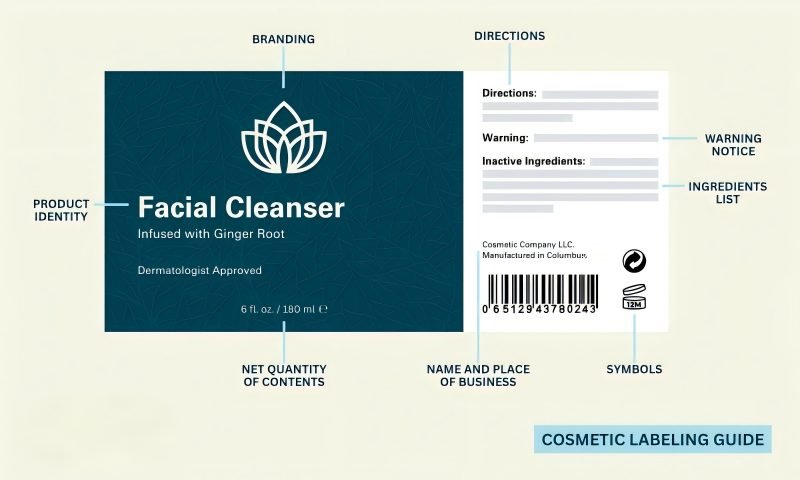
A compliant custom cosmetic label is one that is complete, readable, and legally meaningful—it carries the required identity, net contents, ingredient declaration, responsible business details, and any needed warnings, in the right place and format.
In practice, “compliant” means you can pass three fast tests: (1) required elements are present and conspicuous, (2) INCI/ingredient rules and net contents rules are followed, and (3) claims don’t turn your cosmetic into a drug/OTC product by accident.
What label elements are non-negotiable for cosmetics?
Non-negotiables are the items that—if missing or misleading—typically create an immediate “stop” in retail onboarding, marketplace listing, customs checks, or a regulatory review.
The “must-have” label elements (Ready checklist)
| Required element | What it must do | Where it usually must appear | Common failure mode |
|---|---|---|---|
| Product identity / function | Clearly states what it is (e.g., “Face Cleanser”, “Body Lotion”) | US: principal display panel rules apply; EU: must be on container/packaging if not obvious | Brand name only; function unclear |
| Net contents / net quantity | Weight/volume/count stated in the correct format | US: strict placement & formatting expectations; EU: nominal content with exceptions | Missing on PDP; wrong unit type for viscous vs liquid |
| Ingredient declaration | Ingredients listed per rules (order, naming, grouping) | Often info panel/back label; sometimes carton only | Non-INCI names; wrong order; hiding allergens improperly |
| Name & place of business / responsible party | Traceable business identity and address | US & EU both expect a responsible business entity shown | Distributor shown but no traceable address; mismatched company names |
| Warnings & directions (as needed) | Appropriate cautions for safe use when required | Must be prominent and legible | Missing aerosol/feminine spray cautions; tiny text |
| Batch/lot code | Enables traceability for complaints/recalls | EU requires batch/reference; US strongly expected operationally | No batch code method defined; code rubs off |
If you’re building a private-label label + carton workflow (die-lines, finishes, label stock, and print tolerances), keep your packaging plan aligned with your label risk points—see Cosmetic Packaging Sourcing for packaging constraints that affect compliance (space, material compatibility, coding).
How should INCI and allergen-related info be handled?
This is where “custom label” projects most often fail—because the artwork looks right, but the ingredient language is wrong, or the order/threshold rules aren’t followed.
INCI order rules (the parts buyers should spot-check)
- Descending order by predominance is the default (with allowed grouping exceptions).
- ≤1% ingredients can be listed without strict order in both US and EU frameworks (handled slightly differently, but the intent is similar).
- Fragrance/flavor naming: In the US, fragrance or flavor may be listed as “fragrance”/“flavor” under the rule.
For a direct look at the US ingredient declaration rule, reference: 21 CFR § 701.3 (Designation of ingredients).
EU-specific “allergen-related” handling (high-level, label-facing)
- EU labeling requires the ingredient list to use the “ingredients” term, and it sets explicit rules for parfum/aroma plus additional substances that must be declared (linked to Annex restrictions).
- EU also requires nanomaterials to be indicated with “nano” in brackets.
If your brand is mapping US + EU text into one shared label, do a versioned “ingredient + claims lock” before print (we use the same discipline described in FDA cosmetic compliance documents under MoCRA so artwork doesn’t drift after regulatory review).
Which claims on labels create the biggest compliance risk?
Claims are label text, and label text can redefine your product’s legal category.
The risk rule buyers use
If the label implies your product treats/prevents disease or affects the structure/function of the body, regulators may treat it as a drug/OTC (even if you call it a cosmetic).
Common “label-trigger” claim patterns (and safer directions)
High-risk: “treats acne”, “kills fungus”, “heals eczema”, “regrows hair” → can imply drug intent.
Lower-risk direction: “helps reduce the appearance of blemishes”, “helps improve the look of redness”, “hair looks fuller”.
High-risk: “anti-inflammatory for dermatitis”, “medical-grade”, “FDA approved” (cosmetics generally aren’t FDA pre-approved) → misbranding/false implication risk.
Lower-risk direction: “dermatologist tested” (only if true), “clinically evaluated” (define what was measured).
High-risk: “SPF 50” on a cosmetic-only product → sunscreen claims are regulated as drugs in the US.
Lower-risk direction: avoid SPF unless you are launching as the correct regulatory category.
EU also explicitly prohibits using labeling/marketing to imply characteristics the product does not have.
What batch code, PAO, and traceability info should appear?
This is the “ops reality” layer of compliance: you’re proving you can trace, investigate, and correct.
EU: batch, durability, PAO, and origin are written into labeling rules
EU labeling requires:
- Batch number / reference for identifying the cosmetic product.
- Date of minimum durability, and if durability is more than 30 months, a PAO (period-after-opening) indication instead.
- Country of origin specified for imported cosmetic products.
For the full EU list in one place, see EU Cosmetics Regulation (EC) No 1223/2009, Article 19 (Labelling).
US: country-of-origin marking is also a real checkpoint
For products entering the US, country-of-origin marking requirements are enforced through customs rules (even when it’s not your “marketing focus”), and the expectation is conspicuous, legible origin marking unless an exception applies.
What changes between US and EU label expectations?
Here’s the fastest EU vs US cosmetic label differences checklist buyers use when deciding whether to run one universal label or maintain two versions.
| Topic | US label focus | EU label focus |
|---|---|---|
| Required party shown | Manufacturer/packer/distributor identity and address conventions | “Responsible person” name & address; PIF address logic |
| Ingredient rules | Ingredient declaration rules in 21 CFR; grouping allowances | “Ingredients” term; descending order; nano marking; parfum/aroma handling |
| Allergens | No EU-style mandatory fragrance allergen list on-pack as a single rule | Additional substances may need declaration beyond parfum/aroma via Annex rules |
| Durability / PAO | Less standardized on-pack conventions in cosmetics (depends on risk/positioning) | Date of minimum durability; PAO required for >30 months cases |
| Language | English expectations for required statements under US rules | Member State language rules for key information |
| Claims discipline | Claims can reclassify a product as drug/OTC | Claims must not imply false characteristics; common criteria framework exists |
| Country of origin | Import marking enforced at customs for imported goods | Country of origin specified for imported cosmetic products |
If you’re designing labels and cartons together, keep your dieline decisions and text hierarchy aligned in Custom Cosmetic Box & Label Design so you don’t “win” a design that can’t fit compliance text legibly.
What pre-print checks prevent costly relabeling?
Pre-print failure is expensive because it multiplies: wasted labels/cartons, delayed inbound inventory, marketplace listing rejections, and sometimes rework at the 3PL.
Pre-print compliance checks (the 15-minute checklist)
| Check | What to verify before print | Why it prevents relabeling |
|---|---|---|
| Ingredient list lock | Final INCI names + order match the signed formula revision | Avoids “formula vs label” mismatch |
| Net contents format | Correct unit type (weight vs volume) + correct placement/legibility | Prevents immediate PDP noncompliance |
| Warnings & directions | Required warnings present; font size readable for the pack size | Avoids safety/misbranding issues |
| Claims screening | Remove drug/OTC-trigger claims; align with substantiation you actually have | Prevents reclassification or enforcement attention |
| Traceability plan | Batch/lot code location + print method + rub resistance confirmed | Avoids traceability failure during complaints |
| EU durability logic (if applicable) | Minimum durability date vs PAO decision (>30 months) is correct | Prevents EU relabeling at import |
| Country-of-origin marking | Origin text present where required for import pathways | Avoids customs holds/rework |
| Final proof control | One “golden PDF” with version number + approvals recorded | Prevents silent edits after approval |
Conclusion
A custom cosmetic label becomes “compliant” when it is complete (required elements present), correct (INCI/net contents/traceability rules followed), and cautious (claims don’t overstep the product category). Treat label text as a controlled specification—locked to formula revisions and packaging constraints—so you don’t discover compliance problems only after cartons and labels are already printed.
More Related
How to Vet an “FDA GMP” Cosmetics Suppliers →
Cosmetic Good Manufacturing Practice SOPs→
How To Run GMP Cosmetic Manufacturing Audit→
How To Verify A GMP Factory For Cosmetics →
FDA cosmetic compliance Documents Checklist→
Cosmetics Label Requirements Compliance Checklist→
Cosmetic Manufacturing Contract Agreement key clauses →
Custom Formulations
Hot Private label Beauty products
Hot ingredients
Custom cosmetic solutions
FAQ Categories
Can't find the answers?
No worries, please contact us and we will answer all the questions you have during the whole process of OEM Cosmetic customization.
Make A Sample First?
If you have your own formula, packaging idea, logo artwork, or even just a concept, please share the details of your project requirements, including preferred product type, ingredients, scent, and customization needs. We’re excited to help you bring your personal care product ideas to life through our sample development process.