Skip to content
Custom Hair Volumizing Formulations Manufacturer
Custom Volumizing Solutions for Premium Brands — Build a differentiated line that lifts roots, thickens fiber feel, and sustains airy body without tack or residue. We tailor flexible film networks, sebum/lightweight control, and heat-set lift by hair type and climate, then deliver fast sampling, compliant labeling, and on-brand packaging.
What This Hair Volumizing Solves
Flat, quickly collapsing styles stem from sebum reweighting at the scalp, heavy conditioners, and brittle hold resins that stiffen then wilt in humidity. Our system delivers root lift + airy thickness by blending elastic film formers, featherweight carriers, and oil/shine control that preserves movement. Cationic polymers provide targeted grip on damaged zones without blanket buildup; starch/silica micro-texturizers create micro-separation for fuller silhouettes; low-pH rinse care compresses cuticles for light reflection instead of grease. We calibrate polymers for fine vs. coarse textures, add chelators for hard-water shine, and incorporate heat-activated setting so blowouts hold their shape. From daily “light” shampoos/conditioners to mists, mousses, powders, and primers, your range can deliver instant lift with touchable softness—silicone-optional, fragrance-flexible, and color-care-friendly.


Hair Volumizing Formula
1.Root-Lift Longevity & Style Retention
Quantify vertical lift at the crown/part using standardized mannequin or tress rigs with time-lapse imaging after blow-dry/iron sets. Track height (mm) and silhouette area at T0/T2/T4 hours under controlled RH (50–75%). Our elastic film networks (pullulan/acrylates + polyquats) set with heat to preserve root elevation while avoiding helmet stiffness. Report Δ% retention vs. control and include panel ratings for “soft feel” and “brushable hold,” demonstrating consumer-relevant performance across hair densities and lengths.
2. Apparent Fiber Thickness & Body Index
Measure apparent diameter/body via bundle cross-sectional imaging or laser micrometry proxies, plus air-permeability or 3D volumetry to reflect micro-separation. Featherweight texturizers (hydroxypropyl starch phosphate/silica) and quat-functional polymers deliver thickness without tack, while hemisqualane carriers keep glide high. Express results as Δ% “body index” and Δ perceived thickness in panel tests, linking metrics to consumer language like “fuller ponytail,” “more lift at roots,” and “lasting bounce” across fine/straight and wavy hair.
3. Humidity-Resistant Volume with Low Residue
In 75–90% RH chambers (25–30 °C), monitor collapse by measuring reduction in lift height and increase in halo/flatness with image analysis at T0/T2/T4 hours. Flexible, non-brittle films resist plasticization while sebum-moderating toners (e.g., zinc PCA/niacinamide, optional) delay reweighting. Use comb-force and tactile tack tests to prove low residue/greaseless touch. Communicate “stays airy in humidity” and “re-liftable with brush” supported by multi-wash tolerance and restyle data that matter for busy consumers and stylists alike.
Key Hair Volumizing Actives & Technologies
Elastic film + featherweight texture: Flexible styling resins and polyquats create lift and light grip; starch/silica micro-texturizers add separation; hemisqualane maintains slip minus weight; low-pH, chelation, and scalp oil-control options preserve shine and volume in real climates.
Key Ingredients & Their Benefits
| Ingredient (INCI) | Role in System | Typical Use Levels | Formulation Notes | Compliance & Market Proof |
|---|---|---|---|---|
| Pullulan | Elastic film, brushable hold | 0.1–1% | Great in sprays/mists; flexible, non-crunch | Wikipedia – Pullulan |
| VP/VA Copolymer / PVP | Classic lift resin | 0.5–5% | Blend for humidity tolerance; avoid brittleness | CosmeticsInfo – PVP |
| Polyquaternium-11 / -4 / -16 | Cationic film & grip | 0.2–2% | Targeted deposition; improves combing + style memory | CosmeticsInfo – Polyquaterniums |
| AMP-Acrylates Copolymer | Humidity-resistant hold | 0.5–4% | Neutralize to clarity; good in sprays/mousses | CosmeticsInfo – Acrylates |
| Hydroxypropyl Starch Phosphate | Featherweight texture | 0.5–3% | Adds micro-separation; reduces slip-only feel | CosmeticsInfo – Starches |
| Silica (sphericals) | Dry lift / oil mop | 0.5–2% | Ideal for powders; test dusting & feel | Wikipedia – Silica |
| C13-15 Alkane (Hemisqualane) | Ultra-light carrier | 1–8% | Fine-hair friendly; fast-dry, non-greasy | CosmeticsInfo – Alkanes |
| Polyquaternium-55 / -68 | Flexible film former | 0.2–2% | Gloss + humidity control; blowout primers | CosmeticsInfo – Polyquaterniums |
| Zinc PCA (optional) | Scalp oil moderation | 0.1–1% | Pre-style toner to delay reweighting | Wikipedia – Zinc PCA |
| Niacinamide (optional) | Scalp-care story | 1–3% (rinse-off/toner) | Complements oil-control narratives | Wikipedia – Niacinamide |
| Tetrasodium Glutamate Diacetate / Disodium EDTA | Chelation | 0.05–0.3% | Hard-water shine, improves feel | Wikipedia – GLDA, Wikipedia – EDTA |

Pullulan — Customization Details for Hair Volumizing
1. INCI & CAS
INCI: Pullulan · CAS: 9057-02-7 · Fermentation-derived polysaccharide (Aureobasidium pullulans); film-forming/binder for skin, hair, and make-up. (EU CosIng; PubChem; COSMILE Europe functions). (European Commission)
2. Role in Hair Volumizing
Mechanism: creates a lightweight, flexible film on hair fibers that stiffens at the root, increases inter-fiber friction, and delivers touchable lift/hold without heavy residue—ideal for root-lift sprays, volume powders, and mousse/foam. Supplier tech and literature note pullulan’s adhesiveness + film-forming enhancing hair styling performance. (Nagase/Hayashibara brochure; cosmetics polymers review). (NAGASE)
3. Typical Use Levels (formulation custom guide)
Root-lift/volumizing sprays & mists: 0.5–3% (often with 20–35% ethanol for faster dry, natural hold). (SCI DIR)
Styling gels/foams/mousses: 0.5–3% (pair with VP/VA, polyquats, or starch/silica texturizers).
Powder texturizers/dry volume products: 0.2–2% (binder/anti-dusting).
Leave-on hair tonics/finishers: market data show use up to 12% in leave-ons (CIR survey of concentrations).
Processing: add to water phase; hydrate before high-alcohol addition; typical as-is pH 5–7; cool-down recommended. (CIR microbial polysaccharide gums; supplier TDS). (cir-safety.org)
4. Regulatory Sources & Global Compliance
EU Cosmetics Regulation (EC) No 1223/2009: not specifically restricted; use subject to product-level safety report (PIF). (EUR-Lex consolidated).
EU CosIng: Pullulan listed with FILM FORMING/BINDING functions. (CosIng entry).
China IECIC (2021; 2025 two-tier updates): Pullulan is part of the existing ingredient inventory; NMPA now manages List I/II with rolling revisions—verify current listing for dossiers. (IECIC explainer; NMPA update; database links).
U.S. FDA (food context): GRAS notices for pullulan (food use) acknowledge safety in foods; note GRAS ≠ cosmetic approval, included for toxicology context. (FDA GRN 99 and related pages). (CosmeticsBridge)
5. Clinical/Instrumental Evidence (volumizing/hold)
Hair fixative role: patents and reviews document pullulan-based hair fixative systems delivering natural hold and improved drying times (with ethanol co-solvent), supporting volume retention after styling. Supplier data highlight adhesion/film properties for hair styling products. (Hair-fixative patents; ScienceDirect overview; Nagase brochure). (Patent Google)
6. Safety & Risk Assessment (toxicology highlights)
CIR review (Microbial Polysaccharide Gums): Pullulan is safe as used in cosmetics; reported leave-on hair grooming aids up to 12%. NICNAS/AICIS public report indicates low hazard with typical consumer exposures across shampoo/styling scenarios. Always confirm microbiology, impurities, and allergen statements via supplier COA; conduct HRIPT where appropriate. (CIR PDF; NICNAS public report). (cir-safety.org)
7. Processing, Stability & Packaging
Water-soluble; hydrate fully (premix with glycerin if needed). Compatible with alcoholic sprays (optimize viscosity/atomization). Store cool/dry; typical TDS shows 24-month shelf life sealed. Package finished goods in propellant or pump packs with fine spray hardware for even root deposition; validate spray pattern, drying time, and flake resistance. (Supplier TDS/usage notes). (avenalab.com)
8. Cost–Benefit
“Natural-origin film former” with COSMOS/Ecocert-friendly positioning; delivers clean-beauty story, good sensory, and scalable supply (major producers). Strong marketing recognition plus multi-format versatility (sprays/foams/powders) enable cost-effective volumizing claims. (Nagase/Hayashibara update; industry coverage). (Cosmetics & Toiletries)
9. Claims Language (Do/Don’t)
✅ Helps add body and root lift with light, flexible hold.
✅ Helps improve volume retention and reduce collapse in humidity-prone styles.
✅ Supports clean, non-tacky finish for brushable volume.
❌ Avoid therapeutic/medical claims (e.g., “treats hair loss”) or jurisdiction-specific approvals; align claims with instrumental endpoints (volume retention, drying time, flaking). (EU claims context; polymer fixative literature). (MDPI)

VP/VA Copolymer / PVP — Customization Details for Hair Volumizing
1. INCI & CAS
INCI: VP/VA Copolymer (Vinylpyrrolidone/Vinyl Acetate Copolymer) · CAS: 25086-89-9 · Functions: FILM FORMING/HAIR FIXING/BINDING (CosIng/COSMILE). INCI: PVP (Polyvinylpyrrolidone) · CAS: 9003-39-8 · Non-ionic, water/alcohol-soluble film former/hair fixative (CosIng/COSMILE). (European Commission)
2. Role in Hair Volumizing
Mechanism: VP/VA & PVP form clear, flexible films on fibers, increasing root stiffness and inter-fiber friction for lift and body; VP/VA (VP+VA) is less brittle/less humidity-sensitive than PVP—supporting volume retention in damp climates. (PCPC/ CosmeticsInfo; INCIDecoder polymer note; supplier literature). (Cosmetics Info)
3. Typical Use Levels (formulation custom guide)
Root-lift/volumizing sprays (hydroalcoholic, pump/aerosol): VP/VA ~2–8% solids (Ashland VP/VA grades show 0.5–6% solids use; BASF VA 37 E notes propellant compatibility & plasticizer tips). (ashland.com)
Styling gels/foams/mousses: PVP ~4–7% in gels; VP/VA ~1–6% solids for gels/foams (formulator/ supplier guides). (Making Cosmetics)
Powders/dry volume: 0.2–2% as binder/film former (supplier usage notes). (The Formulator Shop)
Processing: dissolve in water or water/ethanol; add plasticizer (e.g., PEG/silicones) to reduce flaking; DME/propellant compatible per VP/VA TDS. (Shop@BASF)
4. Regulatory Sources & Global Compliance
EU Cosmetics Regulation (EC) No 1223/2009: VP/VA & PVP not specifically restricted; use subject to PIF safety assessment (consolidated text). CosIng/COSMILE list functions and identifiers. China IECIC: Existing-ingredient framework in force; 2025 NMPA two-list (List I/II) update governs ongoing ingredient management—verify current listing during dossier prep. CIR (2018): Vinylpyrrolidone polymers (incl. PVP, VP/VA) safe as used in present practices. (EUR-Lex)
5. Clinical/Instrumental Evidence (volumizing/hold)
High-humidity curl retention & stiff/strong hold are reported for VP/VA grades in styling systems; traditional PVP/VP-VA resins underpin lift and set in gels, mousses, and sprays; polymer literature links film stiffness + humidity resistance to volume retention. (Ashland hair care guide; fixative-polymer reviews/papers). (ashland.com)
6. Safety & Risk Assessment (toxicology highlights)
CIR conclusion: 27 vinylpyrrolidone polymers (incl. PVP, VP/VA) safe in cosmetics as used; historical PVP review “safe as used.” Risk controls: check residual monomer (N-vinyl-2-pyrrolidone) levels, impurities, and aerosol/particle size for sprays; reference ECHA substance info and SDS for workplace handling. (cir-safety.org)
7. Processing, Stability & Packaging
Solubility: water & ethanol; tailor alcohol level for dry-time and lift. Plasticize to reduce brittleness/flaking (PEGs, silicones). Aerosol compatibility: VP/VA solutions show DME/propellant compatibility; filter before filling; validate spray pattern & flake resistance on treated tresses. (BASF Luviskol VA 37 E; VA grades guide). (Shop@BASF)
8. Cost–Benefit
Proven, cost-efficient fixatives with strong consumer recognition; VP/VA offers a balanced “hold vs. humidity” profile vs PVP alone, enabling clean-beauty textures (low odor, clear films) and scalable sourcing (multiple global suppliers). (Ashland/industry overviews; supplier brochures). (ashland.com)
9. Claims Language (Do/Don’t)
✅ Helps add body and root lift with touchable, brushable hold.
✅ Helps improve volume retention and reduce collapse in humidity.
✅ Supports long-lasting style memory without heavy residue.
❌ Avoid therapeutic/medical claims or jurisdiction-specific approvals; anchor claims to instrumental endpoints (curl/volume retention, stiffness, flake rating). (EU claims context; fixative-polymer literature). (EUR-Lex)

Polyquaternium-11 / -4 / -16 — Customization Details for Hair Volumizing
1. INCI & CAS
INCI: Polyquaternium-11 (quaternized VP/DMAMEA copolymer; typical solution grades), CAS: 53633-54-8/— (commercial solutions); Polyquaternium-4 (cationic cellulose derivative), CAS: varies by grade; Polyquaternium-16 (VP/quaternized vinyl-imidazole copolymer), CAS: 95144-24-4. Functions: FILM FORMING / HAIR FIXING / ANTISTATIC / HAIR CONDITIONING (per EU databases). (Cosmetics Info)
2. Role in Hair Volumizing
Mechanism: cationic fixative polymers deposit substantive, flexible films that stiffen roots, raise inter-fiber friction, and retain lift in humidity. PQ-11 (Gafquat™ series) is a classic body-building film former; PQ-4 delivers very high curl retention; PQ-16 provides conditioning + strong set for long-lasting volume. (specialchem.com)
3. Typical Use Levels (formulation custom guide)
Hydroalcoholic root-lift sprays / aerosols: PQ-11 or PQ-16 at ~0.5–4% solids (supplier guides show curl retention at ~2% solids; some polymer brochures recommend 0.25–4%). Gels/foams/mousses: PQ-11 or PQ-4 ~0.5–3%; PQ-4 often 0.1–2% in styling compositions. Processing: dissolve in water or water/ethanol; plasticize (e.g., PEG/silicones) to reduce flaking; validate propellant compatibility. (ashland.com)
4. Regulatory Sources & Global Compliance
EU Cosmetics Regulation (EC) No 1223/2009: PQ-11/-4/-16 are not specifically restricted; use requires product-level safety assessment (PIF). EU CosIng / COSMILE Europe: entries list functions and identifiers for each (e.g., hair fixing/film forming/antistatic). CIR Expert Panel (2023): Polyquaternium-11 is safe as used in current practice. (Check national VOC/aerosol rules for sprays.) (European Commission)
5. Clinical/Instrumental Evidence (volumizing/hold)
High-humidity curl retention & volume: manufacturer studies and hair-fixative literature report strong curl retention and volume maintenance for PQ-11 styling polymers; BASF Luviquat® (PQ-16) brochures show ultra-strong hold with more volume even at high RH; PQ-4 product data highlight very high curl retention in humidity. (stobec.com)
6. Safety & Risk Assessment (toxicology highlights)
CIR conclusion (2023): PQ-11 is safe in the present practices of use and concentration; historical reviews for vinylpyrrolidone polymers also support safe as used determinations. Risk controls: ensure low residual monomer (e.g., N-vinyl-2-pyrrolidone where relevant), confirm aerosol particle size for sprays, and follow SDS for workplace handling. (cir-safety.org)
7. Processing, Stability & Packaging
Solubility: water / hydroalcoholic. Tips: hydrate/fully dissolve polymer; add plasticizer to reduce brittleness/flake; filter before aerosol filling; validate spray pattern, drying time, flake rating on treated tresses. Aerosols: VP/quat solutions show DME/propellant compatibility per TDS. (specialchem.com)
8. Cost–Benefit
Mature, cost-efficient fixatives with broad global supply and consumer-recognized performance. PQ-11 balances conditioning + hold; PQ-4 gives stiff, high curl retention; PQ-16 adds conditioning without sacrificing volume—ideal levers for clean, brushable lift across sprays, mousses, and gels. (specialchem.com)
9. Claims Language (Do/Don’t)
✅ Helps add body and root lift with touchable, brushable hold.
✅ Helps improve volume retention and reduce collapse under humidity.
✅ Supports long-lasting style memory with reduced frizz/static.
❌ Avoid therapeutic/medical claims or jurisdiction-specific approvals; anchor claims to instrumental endpoints (curl/volume retention, stiffness, flake rating). (European Commission)
Custom Hair Volumizing Product Applications
Cover wash care, featherweight conditioning, mists, mousses, powders, and heat primers, enabling daily maintenance and long-wear lift without stiffness. Texture-calibrated formats for fine to coarse hair deliver root elevation, airy thickness, and humidity resilience, while low-pH/chelation safeguards color and hard-water shine.


Hair Volumizing Market Trends & Target Audiences
Search demand for volumizing shampoo, thickening spray, and root lift remains strong as consumers seek airy fullness that survives humidity. “Fine-hair friendly,” “silicone-optional,” and “non-crunch hold” drive clicks, with repeat purchase peaking around seasonal humidity and post-salon blowout maintenance.

Market Overview
Category winners pair credible lift metrics with soft, brushable feel. Texture-specific SKUs—fine-friendly mists/primers vs. richer mousses—improve conversion and bundling. Clean-lean narratives with fragrance options and color-safe care satisfy retailer standards while sustaining star ratings. Anti-humidity claims framed as “lasting lift” resonate across DTC and salon channels.
Key Market Insights:
- Measured lift sells: height retention, Δ body index, and humidity tests.
- Texture targeting: fine hair = mists/primers; dense hair = mousses/powders.
- Scalp-first logic: oil-control toners delay collapse, boosting satisfaction.

Target Consumer Segments
Fine/limp hair needing credible root lift; blowout lovers wanting humidity endurance; wavy/straight users seeking airy fullness without stiffness; oily-scalp consumers battling rapid collapse; and clean-lean shoppers preferring silicone-optional formulas with tailored fragrance. Salon-home hybrids value brushable, reworkable styles that revive between washes.
Target Segments after Custom Branding:
- Everyday Airy Volume Line: Light shampoo/conditioner + thickening mist.
- Pro Blowout & Humidity Defense Line: Heat primer + mousse + chelation care.
- Second-Day Revival Line: Texturizing powder + scalp toner for oil control.
Customization Options for Packaging & Branding
Explore flexible packaging options, bottle types, and private label services. From tube to jar, we match your brand’s tone and market position.
Cosmetic formulation development
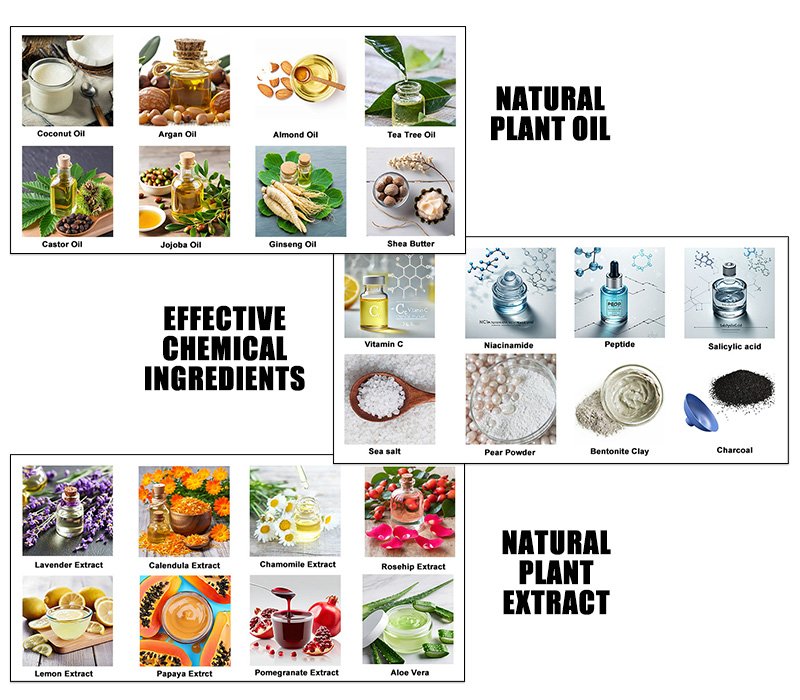
Your formula is the soul of your brand. Whether you’re developing a gentle serum for sensitive skin, a high-efficacy anti-aging cream, or a scalp-purifying shampoo, our in-house chemists create custom cosmetic formulations tailored to your desired effect, skin type, region, and ingredient philosophy.
With over 5,000+ proven base formulas and full white-label development support, we help you build a product that meets your performance goals, brand values, and market trends.
Available Services:
Active ingredient sourcing & formulation balancing
Custom texture creation: gel, cream, balm, lotion, foam, oil
Ingredient selection for target concerns: anti-acne, brightening, anti-aging, hydration
Support for natural, vegan, EWG green-level formulations
Regional compliance: USA, EU, AU, JP standards
Custom Cosmetic Packaging Styles
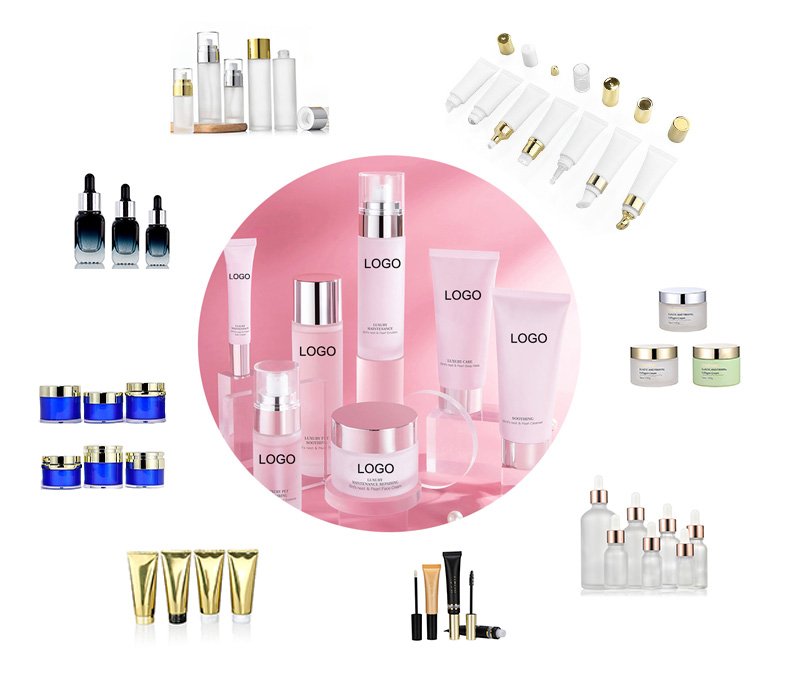
Packaging plays a critical role in how your brand is perceived. Whether you need luxury glass droppers, airless pump bottles, eco-friendly refill pouches, or retail-friendly PET tubes, we provide 3000+ stock and customizable packaging options.
From minimalist matte finishes to glossy foil-stamped designs, our packaging engineers help you select the perfect form and material—whether for prestige skincare, professional haircare, or clean beauty positioning.
Available Options:
Glass, PET, PP, PCR, aluminum, bamboo, and more
Airless pumps, sprayers, jars, tubes, and dropper bottles
Color-matching, texture finishes, and custom mold services
Cosmetic Box, Label Design for skincare brands
Beyond the bottle, your visual identity sets your product apart. Our in-house design team creates custom label layouts, box designs, and full branding suites—including logo placement, font matching, and barcode compliance.
We also offer waterproof labels, UV spot gloss, embossing, foil stamping, and other premium finishes to ensure your packaging feels as high-end as your formula. Whether you’re building an Amazon FBA product or a salon-grade kit, we help make your product shelf-ready.
Design Services Include:
Free artwork design and dieline support
Amazon & retail barcode setup (FNSKU/UPC)
Custom printing on labels, boxes, pouches, and shrink wraps
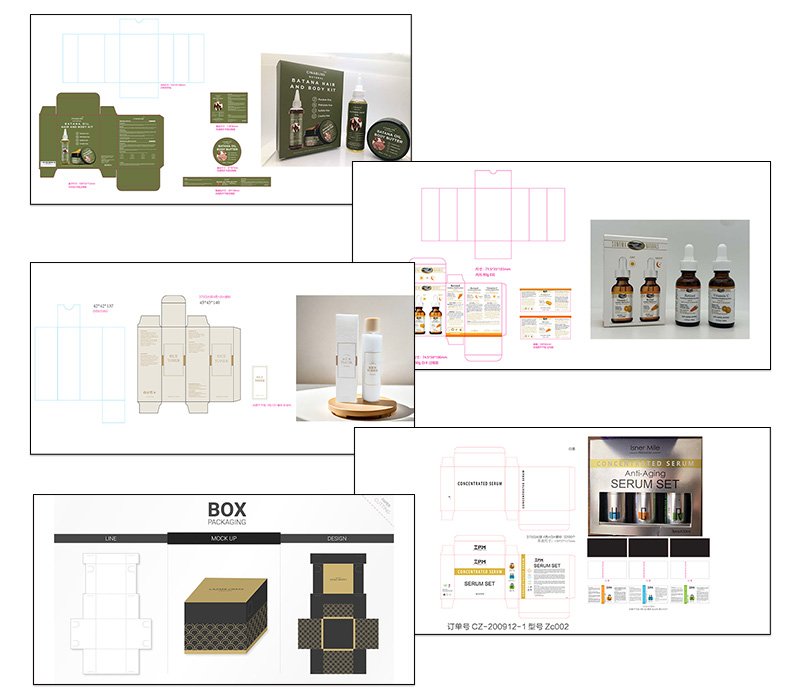
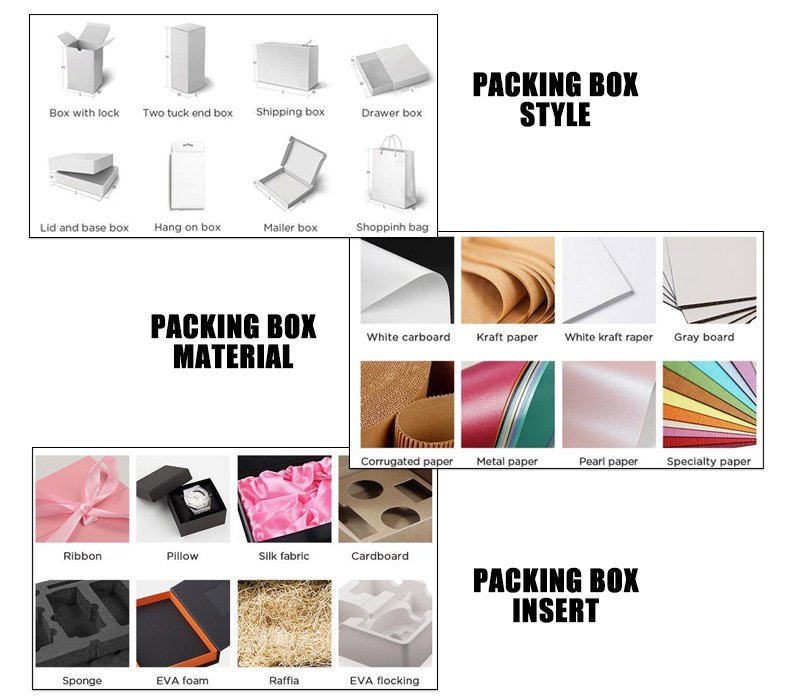
Cosmetic Box Customization for Skincare Brands
Beyond the bottle, your outer packaging is your first impression. Our team provides custom cosmetic box solutions with tailored box styles, premium cardboard or specialty paper choices, and protective inserts in EVA, molded pulp, or PET.
We also offer specialty printing options, matte or glossy lamination, foil stamping, embossing, and spot UV to create a tactile, luxury feel. Whether for boutique retail, e‑commerce, or professional kits, we ensure your packaging enhances your brand story.
Customization Options Include:
Box style selection: tuck‑end, drawer, magnetic, or folding carton
Material choices: rigid board, kraft, coated paperboard
Insert options: EVA foam, molded pulp, PET, or cardboard
Cosmetic Box Logo Finishing for Premium Branding
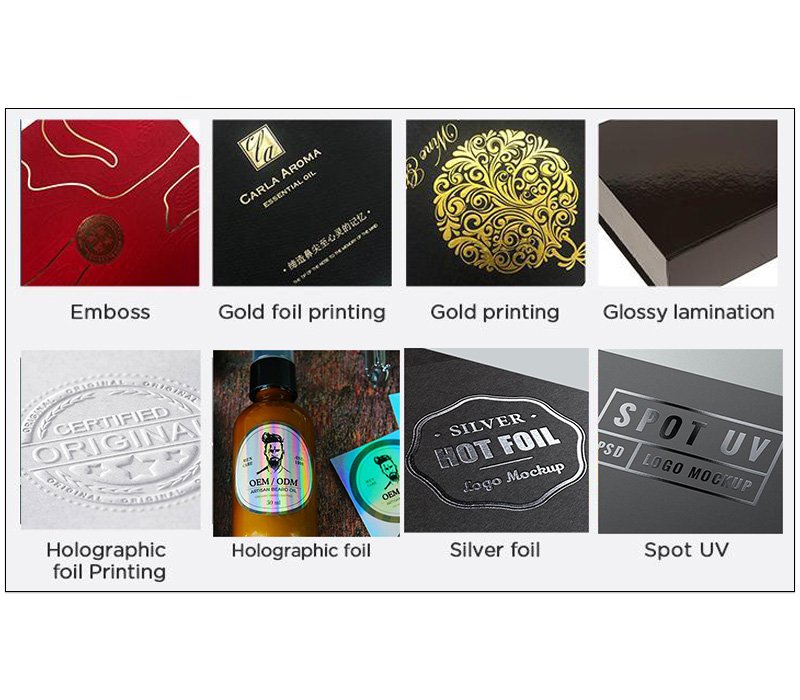
Beyond structure, your logo finish defines your product’s luxury appeal. We offer custom cosmetic packaging logo treatments including emboss, gold foil printing, silver foil, glossy lamination, holographic effects, and spot UV for high-impact shelf presence.
From subtle debossed textures to striking holographic foil, each technique is chosen to enhance your brand story and match your target market positioning. Whether for upscale retail, e‑commerce, or professional use, our finishes help your product stand out.
Finishing Options Include:
Emboss & Deboss logo impressions
Gold, silver, and holographic foil stamping
Spot UV for selective gloss highlights
Glossy or matte lamination for surface protection
Make A Sample First?
If you have your own formula, packaging idea, logo artwork, or even just a concept, please share the details of your project requirements, including preferred product type, ingredients, scent, and customization needs. We’re excited to help you bring your personal care product ideas to life through our sample development process.
More Hair Volumizing product customization instructions and FAQs
Our formulations: Products in this category prioritize root-lift, strand-thickening, and airy fullness without stickiness or collapse. These volumizing systems build space between fibers, control sebum at the roots, and resist humidity so styles hold their shape. The goal is to increase apparent density and bounce by creating lightweight films, adding micro-texture, and preventing moisture-driven droop. Formats include volumizing shampoos, light conditioners, blow-dry primers, root-lift sprays, thickening lotions/mousses, and texturizing powders—each tuned for fine, normal, or limp hair with clean sensorials, fast flash-off, easy brush-out, and salon/e-commerce readiness.
Key ingredients and technologies for volumizing care:
- Lift & Memory Polymers: Styling resins (e.g., VP/VA, PVP, acrylate networks) create root support and humidity-resistant hold while remaining brushable. Optimized neutralization balances grip and flexibility so volume lasts without crispness or flaking.
- Strand-Thickening Film Formers: Polyquaternium-11/16/68, pullulan, hydroxypropyl starch phosphate lay micro-thin, flexible films that increase tactile diameter and improve light scattering—delivering fuller, denser-looking lengths with smooth combability.
- Volumizing Powders & Oil-Control Carriers: Silica, rice/tapioca starch, modified clays/zeolites provide instant root-lift and sebum absorption. Shear-responsive powders re-activate with touch, maintaining lift through the day without dulling shine.
- Lightweight Slip Systems (Silicone or Silicone-Free): Volatile silicones or hemisqualane/C13-15 alkane add low-friction glide so fibers separate cleanly instead of clumping. Micro-dosed esters prevent coated weight, keeping fine hair buoyant and soft.
- Heat-Assist Primers & Anti-Humidity Topcoats: Heat-responsive polymers set lift during blow-dry/ironing, then topcoat membranes limit water uptake that causes collapse. Results are re-styleable, with controlled frizz and a polished, airy finish.
For Customize: By integrating lift polymers, strand-thickening films, sebum-smart powders, lightweight slip systems, and heat/humidity management, these builds deliver visible fullness from roots to ends. Hair feels light, springy, and brushable, holding volume longer while maintaining touchable softness—supporting premium positioning and strong repeat purchase across salon and e-commerce channels.
Q: How do we deliver lift without crunch or stickiness?
A: Use elastic films (pullulan/acrylates) blended with polyquats for brushable hold. Keep oil phases minimal, rely on hemisqualane for slip, and avoid high-Tg resins that snap under humidity. Validate with panel “soft feel” and comb-force/tack tests.
Q: Will volumizing products flatten color-treated hair?
A: Not when designed with low-pH rinse-outs, chelators for limescale gloss, and color-safe surfactants. Avoid heavy silicones or high-wax loads that mute tone. Communicate “color-safe volume” supported by gloss Δ and lift retention post-color.
Q: How do we prevent rapid collapse on oily scalps?
A: Add a pre-style scalp toner using zinc PCA/niacinamide (where appropriate) and low-residue styling formats. Educate to apply at roots, blow-dry for set, and refresh with texturizing powder on day two. This delays reweighting without dryness.
Q: What formats suit fine hair best?
A: Mists/primers with low solids and hemisqualane carriers, plus powders for on-demand crown boost. Offer richer mousses only with flexible resins and clear usage guidance. Keep fragrance levels balanced to avoid perceived heaviness.
Q: How do we differentiate vs. “thickening fibers” marketing?
A: Lead with measured lift retention, body index, and humidity endurance, plus re-brushability. If you don’t use fiber-deposit tech, position elastic films + micro-texturizers as a credible, lightweight alternative with fewer residue concerns and easy removal at wash.
Start YourHair Volumizing Line Today
For curls, coils, or dry frizz, our systems deliver lasting smoothness with curl-safe slip or ultra-light glass-hair shine. We customize textures, carriers, and films for every climate and hair type—ready for fast sampling, stability, and scale-up.