
Eye Cream vs Eye Gel: Which Is Better for Your Skincare Routine?
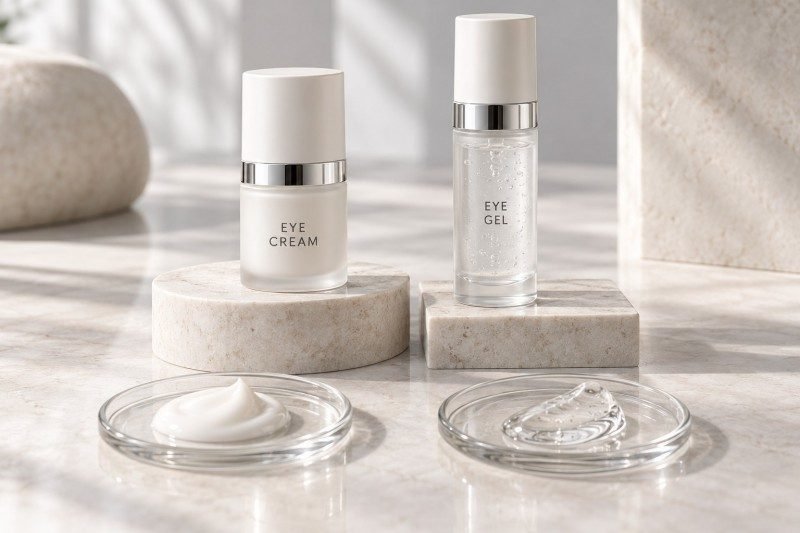
Eye cream usually offers a more conditioning feel, making it a useful starting point for dry-feeling under-eyes and routines that need lasting softness. Eye gel usually feels lighter and fresher, which can suit consumers who prefer less richness or a quick-settling morning product.
Neither format is automatically better for dark circles, puffiness or fine lines. Those benefits depend on the complete formula and the evidence supporting it.
The right choice starts with the experience the product needs to deliver: more cushioning moisture, a lighter hydrating layer or a balance between the two.
For brands planning a private label eye cream, this decision helps guide ingredients, texture, packaging and sample evaluation.
Eye Cream vs Eye Gel at a Glance
Cream and gel describe product formats rather than guaranteed performance levels.
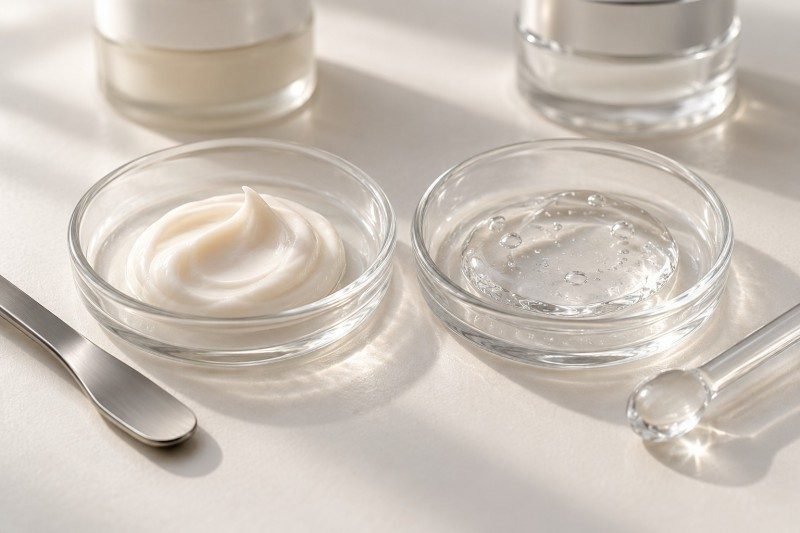
Eye creams are commonly emulsions containing water and an emollient phase. Eye gels commonly use a water-based structure built with suitable gelling ingredients. Gel-creams combine characteristics of both, offering another option when a traditional cream feels too rich but a clear gel feels insufficiently conditioning.
| Comparison | Eye Cream | Eye Gel |
|---|---|---|
| Typical structure | Water-and-emollient emulsion | Usually a water-based gel |
| Application feel | Creamy, soft or cushioned | Fresh, light or slippery |
| Moisturizing emphasis | Hydration plus emollient conditioning | Hydration with less richness |
| Common product direction | Dryness care, nourishing care and fine-line appearance | Lightweight hydration and refreshed appearance |
| Possible sensory drawback | Heavy residue or excessive slip | Tackiness, tight film or insufficient conditioning |
| Makeup compatibility | Depends on residue and formula interaction | Depends on film formation and formula interaction |
| Sensitive-skin suitability | Requires finished-formula assessment | Requires finished-formula assessment |
| Cooling sensation | Possible, depending on formulation and applicator | Often associated with the format, but not guaranteed |
| Typical packaging | Tube, pump or jar | Tube, pump or suitable applicator pack |
What Makes Eye Cream Different?
Eye cream typically combines water-binding ingredients with emollients that improve softness and reduce a dry, rough-feeling finish.
That emollient phase gives formulators room to adjust cushion, slip and richness.
An eye cream can be:
A fluid emulsion that spreads quickly
A balanced daily cream
A richer evening moisturizer
A soft gel-cream with a lighter finish
The word “cream” does not necessarily mean thick or greasy.
A well-designed lightweight eye cream can provide conditioning without leaving a heavy layer. A richer cream can suit a different routine where prolonged softness matters more than a quick-settling finish.
The useful question is how much conditioning the intended user needs.
What Makes Eye Gel Different?
Eye gel commonly uses a water-based formula supported by a gelling system.
This structure can create a fresh application with less oily residue than a richer cream. It may appeal to consumers who dislike heavy skincare or want a light product beneath daytime layers.
However, a gel is not simply water with a hydrating ingredient added.
Its performance depends on the balance between:
Humectants
Gelling ingredients
Film-forming materials
Supporting actives
Preservatives
Any solubilized or dispersed ingredients
Too much structure can make a gel stringy or difficult to spread.
A high humectant or film-former load can leave a tacky finish. A formula with very little conditioning may feel pleasant initially but insufficient for dryness-prone under-eyes.
Which Is Better for Dry Under-Eyes?
Eye cream is often the more practical starting point when dryness is the main concern.
A suitable cream can combine water-binding ingredients with emollients, helping the area feel softer and more comfortable after application.
Useful characteristics include:
Easy spreading without excessive rubbing
A cushioned application
Lasting softness
Controlled residue
Enough conditioning for the intended routine
Eye gel can still provide hydration, but a very light gel may not deliver the same conditioned after-feel.
This matters when the user describes the area as feeling dry again soon after applying the product.
For a brand developing one product for dry-feeling under-eyes, a balanced cream or gel-cream may offer a clearer starting direction than an extremely lightweight gel.
Which Is Better for Consumers Who Dislike Rich Products?
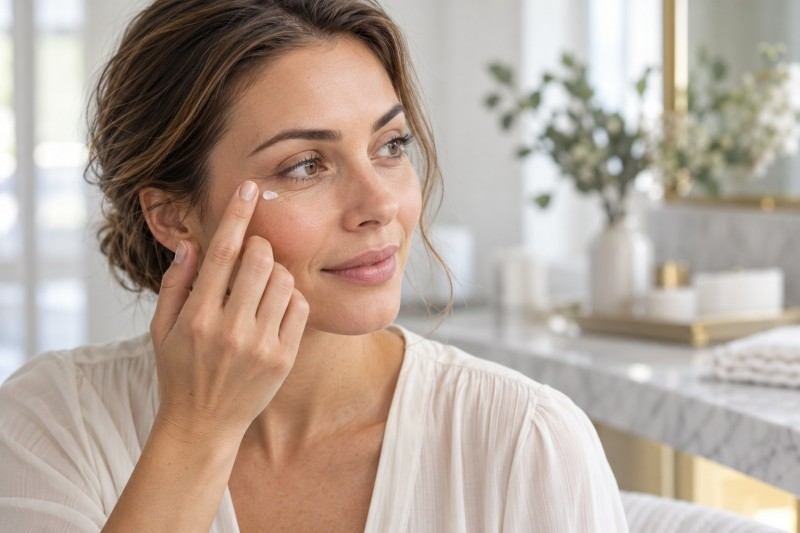
Eye gel often suits consumers who want hydration with less richness.
That preference may be especially relevant in warm weather, humid environments or routines that already contain several moisturizing layers.
A lightweight gel may offer:
A fresh initial feel
Easy distribution
Lower oily residue
A less substantial product layer
A simple morning application
However, facial skin type alone should not decide the format.
Someone with an oily T-zone may still experience dry under-eyes. Someone with generally dry skin may prefer a light gel in the morning and a cream later.
Product selection should follow the eye-area experience and routine rather than a broad skin-type label.
Is Eye Gel Better for Puffiness?
Eye gel is frequently associated with puffiness because its fresh application and lightweight texture fit a morning eye-care routine.
Some products also use ingredients such as caffeine or a cooling applicator.
These features can support a refreshed-feeling experience, but they do not establish that gel is inherently better at reducing puffiness.
The visible result depends on the cause of the appearance concern, the formulation and the evidence for the finished product.
An eye cream can also be developed around refreshed appearance.
For a cosmetic product, the brief should distinguish between:
A cooling application sensation
An immediate visual effect
A measured change in puffiness appearance
These are different outcomes and should not be treated as interchangeable.
Which Is Better for Dark Circles?
Neither cream nor gel is automatically better for dark circles.
Under-eye darkness can involve pigmentation, visible underlying vessels, structural shadowing or a combination of factors. A product that improves one aspect may have limited effect on another.
Texture mainly determines how the product feels and fits into the routine.
A brightening-positioned eye product may focus on:
Immediate Illumination
Optical ingredients can change how light reflects from the area while the product is worn.
Hydration and Surface Smoothness
A moisturized surface may look smoother and less dry.
Gradual Appearance Benefits
Selected ingredients may support an uneven-tone concept, subject to suitability and finished-product evidence.
An illuminating cream and a lightweight gel can therefore serve different needs without either format being universally superior.
Which Is Better for Fine Lines?
The answer depends on whether the concern is mainly dehydration-related surface lines or a broader age-care goal.
For dry-feeling under-eyes, a conditioning eye cream may provide a useful moisturizing experience. Hydration and softness can make surface lines appear less noticeable.
A gel may also improve the appearance of dehydration-related lines when its hydration performance is suitable.
For longer-term fine-line positioning, the active system and supporting evidence matter more than thickness.
A dense cream is not automatically more effective.
Likewise, an immediate tightening sensation from a gel does not prove a lasting improvement in skin firmness.
The product brief should define whether the goal is temporary smoothing, moisturizing care or a substantiated longer-term appearance benefit.
Which Works Better Under Concealer?
Both eye cream and eye gel can work beneath concealer. Both can also cause problems when their residue, film or application amount does not suit the makeup routine.
When Cream Feels Too Rich
Excessive residual slip may make concealer move, crease or distribute unevenly.
The solution may involve adjusting the emollient system or reducing the recommended amount.
When Gel Forms Too Much Film
A gel can pill when rubbed or layered with incompatible products.
The gelling and film-forming system may need adjustment.
When Either Product Provides Too Little Conditioning
Concealer may emphasize a dry-looking surface.
The most useful evaluation applies the intended dose beneath representative sunscreens and concealers, allowing the product to settle as directed.
A quick hand test cannot fully predict under-eye makeup performance.
What Causes Eye Products to Pill?
Pilling occurs when product material gathers into small rolls during application or layering.
It can involve the eye product, the products applied over it, the amount used and the rubbing motion.
Common contributing factors include:
Excessive product application
High polymer or film-former loading
Repeated rubbing
Applying several layers before they settle
Incompatible combinations of skincare and makeup
Pilling is not exclusive to gel products.
Creams can also contain ingredients that form films or interact poorly with subsequent layers.
During development, the aim is to identify the combinations and application conditions that cause the problem, then adjust the formula or directions accordingly.
Is Eye Gel More Suitable for Sensitive Skin?
A lighter feel does not establish better tolerance.
Eye gel can contain fragrance, botanical extracts, solvents or active ingredients that are unsuitable for the intended user. Eye cream can also create discomfort if the complete formula or application conditions are poorly matched.
A comfort-focused eye product should consider:
Ingredient suitability for the intended application area
Appropriate use levels
Fragrance direction
Preservation
Final pH
Product migration
Recommended application amount
Fragrance-free development may fit the positioning, but it does not guarantee an irritation-free product.
Skin tolerance and eye-area comfort should be evaluated for the finished formula, using an approach appropriate to its intended use.
Can a Rich Eye Cream Cause Milia?
It is too simplistic to say that all rich eye creams cause milia or that eye gels prevent them.
Milia are small keratin-filled cysts, and their occurrence cannot be reliably predicted from whether a product is called a cream or gel.
For product development, a more useful approach is to assess whether the formula feels unnecessarily heavy or leaves excessive residue for the target audience.
A lighter emulsion or gel-cream may improve acceptance when users dislike a coated finish.
That is a sensory decision. It should not become an unsupported “milia-free” guarantee.
Persistent or uncertain bumps also fall outside what a cosmetic format comparison can diagnose.
Morning Eye Care vs Evening Eye Care
Morning and evening routines can create different texture priorities.
| Routine | Useful Product Characteristics | Formats to Explore |
|---|---|---|
| Morning skincare | Controlled residue and comfortable layering | Lightweight cream, gel or gel-cream |
| Concealer preparation | Surface softness with limited residual slip | Balanced emulsion or carefully designed gel-cream |
| Evening moisturizing care | More conditioning and a comfortable finish | Cream or richer emulsion |
| Warm-weather routine | Fresh application and lower heavy residue | Gel or fluid emulsion |
| Dry-weather routine | Stronger moisturizing support | Cream or conditioning gel-cream |
These are starting directions rather than fixed rules.
One well-balanced formula may work across both routines, particularly when the brand wants a simple first product.
When Does a Gel-Cream Make More Sense?
Gel-cream can be useful when the target experience sits between a clear gel and a traditional cream.
It combines a fresh, structured application with an emollient contribution.
This may suit a brief asking for:
More conditioning than a watery gel
Less richness than a nourishing cream
A soft, cushioned application
Lower greasy residue
Comfortable daytime layering
The format still requires careful balancing.
A gel-cream can become tacky, heavy or unstable if its structure and emollient phase are poorly matched.
Its value comes from the finished experience, rather than the hybrid name alone.
Packaging Changes How the Product Is Used
Packaging influences dose, application and perceived texture.
A light gel in an oversized pump may dispense too much. A thick cream in a narrow nozzle may require excessive pressure. An attractive applicator may feel uncomfortable or be difficult to clean.
| Packaging Format | Useful For | Main Development Check |
|---|---|---|
| Precision tube | Small, controlled dispensing | Nozzle output and product flow |
| Airless pump | Convenient repeat dosing | Pump output, priming and evacuation |
| Small jar | Easy access to richer textures | Handling and amount picked up |
| Smooth-tip applicator | Direct application and a distinctive sensory experience | Surface finish, dose and formula flow |
| Roller applicator | Selected fluid formulas | Ball movement, leakage and consistent delivery |
A metal applicator may feel cool initially. That sensation alone does not substantiate a de-puffing claim.
Final packaging should be evaluated with the approved formula.
Common Eye Cream and Eye Gel Development Mistakes
Choosing Texture Before Defining the Main Need
A fresh gel and a rich cream solve different sensory needs. The product goal should come first.
Assuming Richer Means More Effective
Richness can improve conditioning, but it does not establish superior results for every concern.
Assuming Clear Gel Means Gentle
Transparency and lightness do not establish eye-area suitability.
Using Cooling as Proof of Performance
A cooling sensation and a measured appearance benefit require different evaluation.
Testing Without Makeup
A daytime eye product should be assessed within representative layering routines.
Overloading the Formula
Too many actives can complicate comfort, stability and the product’s primary purpose.
Ignoring Dose and Migration
Excessive application or uncontrolled spread may affect comfort and makeup compatibility.
Promising to Correct Every Eye-Area Concern
Hydration, dark-circle appearance, puffiness and fine lines need distinct development goals and supporting evidence.
Which Format Should a New Skincare Brand Start With?
For a first launch, choose the clearest need the brand wants to serve.
| Main Product Goal | Starting Direction | Why It Fits |
|---|---|---|
| Dry under-eye comfort | Conditioning eye cream | Combines hydration with emollient softness |
| Lightweight morning hydration | Eye gel or fluid emulsion | Fits a lower-residue routine |
| Balanced daily eye care | Lightweight cream or gel-cream | Offers a middle ground between freshness and conditioning |
| Makeup preparation | Individually tested cream or gel-cream | Layering performance is the deciding factor |
| Rich evening care | Nourishing cream | Supports a more substantial moisturizing experience |
| Refreshed appearance | Gel, gel-cream or light cream | Formula and evidence determine the benefit |
A new brand does not necessarily need separate cream and gel products.
One well-positioned formula may provide a stronger starting point than two products with overlapping benefits.
How Zerun Supports Eye Care Product Development
Shenzhen Zerun Cosmetics Co., Ltd. supports eye-care development around the intended benefit, texture and application routine.
The starting direction may be a fluid emulsion, gel-cream, conditioning eye cream or another suitable format for laboratory assessment.
Project discussions can cover:
The primary eye-area care goal
Hydration and emollient balance
Texture, slip and after-feel
Fragrance-free or selected fragrance requirements
Makeup-layering priorities
Packaging and dispensing
Sampling and evaluation needs
Share your target market, reference product, preferred texture, packaging idea and expected quantity.
Explore our private label eye cream development options to plan a product around your brand’s intended routine.
Request Formula Proposal
Conclusion
Eye cream is often a useful starting point for dry-feeling under-eyes and routines that need more conditioning. Eye gel often suits consumers who prefer freshness, lightness and less rich residue.
Gel-cream provides another option when both qualities matter.
For dark circles, puffiness and fine-line appearance, the complete formula and supporting evidence matter more than the format name.
The best choice is the product that delivers the intended moisture, comfort and layering experience consistently.
More Related
Custom Formulations
Custom Brightening Formulations→
Custom Anti-Aging Formulations→
Custom Sunscreen Formulations→
Custom Acne Treatment Formulations→
Custom Sensitive Skin Care Formulations→
Custom Hair Growth Formulations→
Custom Anti Hair Loss Formulations→
Custom Smooth And Shine Hair Formulations→
Custom Anti Frizz Formulations→
Custom Hair Gloss Formulations→
Custom Anti Static Hair Formulations→
Custom Hair Moisturizer Formulations→
Custom Hair Nourishing Formulations→
Custom Hair Strengthening Formulations→
Custom Hair Damage Repair Formulations→
Custom Hair Volumizing Formulations→
Custom Hair Fluffy Formulations→
Custom Curl Defining Formulations→
Hot Private label Hair products
Private Label Hair Growth Oil→
Private Label Anti Dandruff Shampoo→
Private Label Anti Fungal Shampoo→
Private Label Luxury Hair Oil→
Private Label Lightweight Conditioner→
Private Label Peppermint Hair Oil→
Private Label Leave In Conditioner→
Private Label Curl Defining Cream→
Private Label Hair Volume Powder→
Hot ingredients
Custom cosmetic solutions
FAQ Categories
Can't find the answers?
No worries, please contact us and we will answer all the questions you have during the whole process of OEM beauty and skincare products customization.
Make A Sample First?
If you have your own formula, packaging idea, logo artwork, or even just a concept, please share the details of your project requirements, including preferred product type, ingredients, scent, and customization needs. We’re excited to help you bring your personal care product ideas to life through our sample development process.