Skip to content
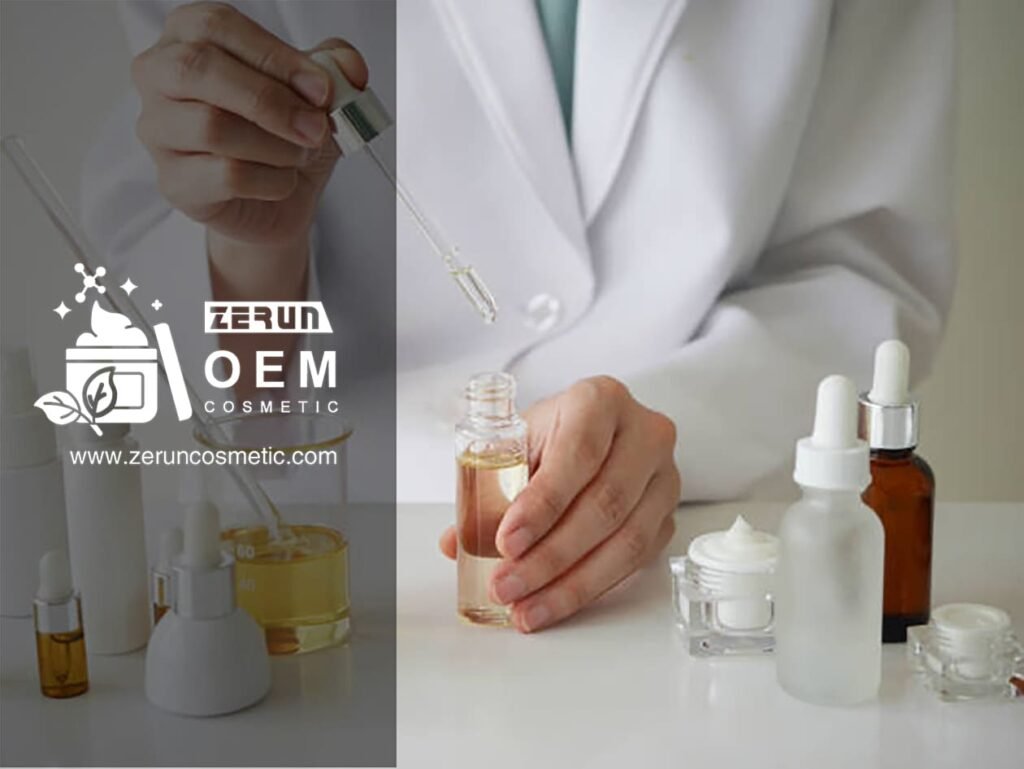
If you’re serious about launching or upgrading a skincare line, you already know ideas are cheap and execution is expensive. It’s one thing to imagine a brightening serum or a minimalist routine; it’s another to turn that into safe, stable, beautifully packaged products that customers actually trust and reorder. That gap between idea and reality is exactly where skin care manufacturers like us live.
We are Zerun Cosmetic, a skincare factory that has spent years working with overseas small and medium buyers and high-end brand clients. As skin care manufacturers, we help you transform concepts into logo-ready products by handling formulation, sampling, packaging, filling, and quality checks under one roof. Instead of building your own factory, you plug into our existing system while keeping control of your brand, positioning, and customer relationships.
Choosing a skin care manufacturer like Zerun Cosmetic means you get a partner who understands both the “lab language” of pH, viscosity, and preservative systems and the “brand language” of positioning, claims, margins, and timelines. In this article, we’ll speak to you directly as Zerun: how we work, why many brands outsource to us, how we manage MOQs and timelines, and what a healthy, long-term partnership looks like from both sides. Our goal is to make the manufacturing side feel less mysterious and more like an understandable, manageable part of your business.
What do we actually do for your brand as a skin care manufacturer?
As a skin care manufacturer, we act as your product and operations engine. You bring your brand story, target customer, and sales channels; we translate that into formulas, textures, packaging, and production steps that can be repeated batch after batch. From our point of view, success means that every product leaving our factory feels like a physical version of the concept you had in your head.
How do we turn your brand idea into a clear skincare concept?
When you first contact us, your idea is usually expressed in emotional or marketing terms: “a gentle brightening serum”, “a simple routine for men who hate complicated skincare”, or “a spa-like body cream that feels luxurious but is still affordable”. That language is perfect for customers, but we need to turn it into something a laboratory can actually build.
We start by asking you some straightforward questions:
- Who is your core customer – age range, skin type, lifestyle, spending power?
- What is your brand personality – clinical, minimalist, playful, natural, luxury?
- Which reference products do you like – textures, scents, packaging styles, finishes?
- Where will you sell – online, in salons, in clinics, in retail stores?
- What are your must-have claims (for example, “fragrance-free”, “for sensitive skin”, “non-sticky”, “dewy finish”)?
From your answers, we create one or more product directions. For example, we might suggest a hydrating serum with niacinamide and peptides, a barrier cream with ceramides and panthenol, or a clarifying toner with gentle acids. Each direction balances what you want to say to customers with what we can reliably manufacture and support long term.
What happens during our R&D and sampling process?
Once we agree on a direction, our lab team starts working on actual formulas. We create laboratory batches, test basic properties like pH and stability in the short term, and then send you samples for evaluation. At this stage, we’re turning “I want a lightweight, non-sticky serum” into something you can pump onto your skin and actually feel. When you receive samples, we encourage you to test them yourself and with people who represent your target customers. Maybe you discover that the cream is rich enough, but you want quicker absorption. Maybe the fragrance feels slightly too strong for your clinic clients. You share those reactions with us in one clear round of feedback, and we adjust texture, scent, or active levels accordingly.
We repeat this loop until we arrive at a “golden sample” that you love and that we know we can produce consistently. That sample becomes the reference for future batches, and our job is to make sure every production run is as close as possible to that approved version.
What do we handle once a formula and packaging are approved?
After you confirm the formula and the packaging, we move from lab mode into full factory mode. For you, this is where the project becomes very real. For us, it’s a well-organized sequence of tasks:
- Purchasing raw materials and packaging components from approved suppliers.
- Scheduling production and assigning the appropriate mixing and filling equipment.
- Preparing bulk product under controlled conditions, with temperature and mixing monitored.
- Filling into bottles, tubes, jars, or pumps, then sealing and labelling or printing your logo.
- Running quality checks on the finished goods and documenting the results.
- Packing products securely in cartons and arranging shipment according to your terms.
From your side, you mainly track milestones: formula approved, packaging approved, production completed, shipment released. The heavy lifting sits with us. Our role is to make the whole process feel predictable and transparent, even though behind the scenes there are many technical steps happening.
In practical terms, what we do for your brand is take you from “rough idea” to “repeatable product”. We translate your concept into a formula, guide you through sampling, manage the production chain, and give you finished, logo-ready skincare that you can confidently put in front of your customers.

Why are more brands—especially smaller ones—choosing manufacturers like us?
We see more and more brands, particularly new and independent ones, choosing to work with skin care manufacturers instead of building their own facilities. From our experience, the main reasons are simple: they want professional products, but they don’t want to carry factory-level risk, cost, or complexity. Working with us lets them access a fully built manufacturing ecosystem while staying lean and focused on the market.
How do we help you avoid heavy fixed investment and reduce risk?
Owning a factory sounds impressive, but in reality it means a long list of fixed costs: buildings, equipment, water systems, HVAC, analytical tools, lab staff, production workers, and ongoing maintenance. For a young or mid-sized brand, that level of commitment can become a trap.
When you work with us, you use our factory only when you have projects. You pay for batches, not for concrete and stainless steel. That changes your risk profile dramatically. You can test a new formula or a completely new category without committing to a permanent production line. If a product doesn’t perform as expected in the market, you adjust your orders; you don’t sit on a facility you can’t easily turn off.
This flexible structure is especially valuable for brands that move fast: influencer-driven labels, cross-border e-commerce sellers, and niche clinic brands. They can try ideas, gather feedback, and refine their assortments without being locked into the infrastructure they built too early.
How do we help you move faster from idea to launch?
Speed is one of the main advantages of working with a manufacturer like us. Because we are developing and producing skincare for multiple clients all year round, a lot of the infrastructure is already in place: tested base formulas, packaging options, supply relationships, and quality procedures.
When you come to us with an idea, we don’t start from a blank page. We can often adapt a base formula in your desired category, then tune texture, actives, or fragrance to your brand. This doesn’t mean you get a generic product; it means you benefit from formulas that have already been tested and adjusted many times.
At the same time, our teams are used to managing parallel projects. While one product is in sampling, another might already be in production, and a third could be in packaging design. We know where delays typically appear – for example, in slow feedback cycles or complex packaging choices – and we try to help you avoid those bottlenecks by planning together.
How do we extend your technical and regulatory capabilities?
Most brands do not have in-house chemists, microbiologists, or regulatory specialists. That’s normal. You shouldn’t have to build all of that just to launch a few strong products. When you work with us, you gain access to our technical team and their daily experience with different formulas, skin types, and market requirements.
We help you choose active levels that make sense for your concept and your target audience. We flag combinations that may be unstable or unsuitable. We provide ingredient lists, basic technical information, and batch records so your local partners can handle registrations, dossiers, or platform onboarding. You still own the responsibility in your home market, but you don’t start from zero.
In-house vs working with us
| Aspect | In-House Production | Working With Zerun Cosmetic |
|---|---|---|
| Investment | High fixed costs for facilities and equipment | Costs mainly linked to actual confirmed orders |
| Speed to market | Long build-up and test period | Faster launch by using existing systems |
| Technical expertise | Must build and train your own team | Use our experienced lab and production teams |
| Flexibility | Harder to change direction quickly | Easier to adjust SKUs, volumes, and product mix |
| Financial risk | You carry full operational and maintenance risk | Risk is more flexible and connected to each project |
Brands, especially smaller and growing ones, choose manufacturers like us because the model is practical. They avoid factory-level fixed costs, reach the market faster, and gain access to a pool of technical and regulatory knowledge that would be difficult and expensive to build internally.

How do we support different brand stages and business models?
Not every brand needs the same depth of customization on day one. Some want to launch quickly and test demand; others are ready to invest in fully unique hero products. As skin care manufacturers, we structure our cooperation models to reflect these different stages, so you don’t have to overbuild or underbuild your first launch.
Which cooperation models can you choose with us?
Broadly, we work with three main models: private label, ODM, and OEM. They are not theoretical labels for us; they are day-to-day ways we serve different types of brands.
- With private label, we use existing formulas and basic packaging, then apply your logo and visual identity. This is the fastest route and usually requires the lowest product development budget.
- With ODM, we start from our formula library but adjust actives, textures, and packaging more deeply to better fit your brand concept.
- With OEM, we build formulas based on your detailed brief, creating products that are highly specific to your brand and long-term strategy.
You don’t need to choose one model forever. Many clients use a mix: a private-label cleanser to enter the market quickly, an ODM serum with a specific texture and claim, and an OEM range as their flagship line once they understand their customers better.
Cooperation models and typical use cases
| Model | What We Provide | Best Suited For |
|---|---|---|
| Private label | Existing formulas + your logo and artwork | Fast launches, testing new markets, starter brands |
| ODM | Library formulas with custom adjustments and packaging | Growing brands, salons, regional distributors |
| OEM | Fully custom formulas based on your detailed brief | Established or high-end brands building hero lines |
Which product categories can we build under your brand?
Our focus is skincare and related categories, but within that space we work across a wide spectrum. That variety helps you build a coherent assortment with one production partner instead of managing multiple factories.
We can support you with:
- Face care – cleansers, toners, essences, serums, creams, sleeping masks, spot treatments.
- Eye care – eye creams, gels, patches, and targeted treatments.
- Body care – lotions, butters, scrubs, brightening or firming products, hand and foot care.
- Hair care – shampoos, conditioners, masks, oils, leave-in treatments, scalp products.
- Beard and grooming – beard oils, balms, cleansers, and after-care products.
This flexibility makes it easier to extend a successful concept into a fuller routine. If your brightening serum performs well, you might later add a matching cleanser, toner, mask, and body product that share the same story and key ingredients.
Main categories we can customize
| Category | Example Products |
|---|---|
| Face care | Gel cleansers, toners, hydrating serums, rich creams |
| Eye care | Cooling gel, nourishing eye cream, eye patches |
| Body care | Body lotion, body oil, exfoliating scrub, hand cream |
| Hair care | Shampoo, conditioner, mask, leave-in spray, scalp serum |
| Beard & grooming | Beard oil, beard balm, beard wash, aftercare products |
How do we help you grow from test batches to full ranges?
We design our cooperation with growth in mind. When you place your first order with us, we are already thinking about what the second and third steps could look like if things go well. That’s not pressure; it’s planning.
Typically, a client might start with one or two core products to test a concept. Once those products prove themselves in terms of sales and customer feedback, we can help you:
- Adjust formulas slightly based on real-world feedback.
- Expand into complementary products within the same range.
- Refine packaging to be more consistent or more premium.
- Move from more generic bases to more customized formulations as your brand identity solidifies.
Because we hold your formula information, packaging specifications, and past production records, your second and third projects with us are usually smoother and faster than your first.
We support different stages and business models through flexible cooperation types and broad category coverage. You can start simple, learn from the market, and then deepen customization and expand your range with the same manufacturing partner, instead of starting over each time.
What capabilities and quality systems should you expect from a partner like us?
When you choose a skin care manufacturer, you’re not just choosing formulas; you’re choosing the way those formulas are made. Our production capabilities and quality systems are what stand between your brand and problems like inconsistency, contamination, or unexpected performance issues. We treat those systems as essential parts of your brand protection.
How do our production capabilities support different kinds of formulas?
Our facility is set up to handle a wide range of textures and formats, from light liquids to thicker creams and emulsions. That matters, because a watery toner and a dense body butter require very different conditions to be made well.
For emulsions and creams, we use mixing systems that can handle the combination of oils, water, and emulsifiers at the right temperatures and speeds. For gels, we ensure the proper blending of gelling agents and active solutions. For sprays and mists, we adapt both formulation and filling to work with chosen pumps and bottles.
This variety of equipment and procedures allows us to support your product ideas without forcing them into the wrong technical shape. Instead of telling you “we only do one texture”, we try to match our tools to your concept as closely as possible, within the limits of safe and stable manufacturing.
How do we structure our quality and process controls?
From our perspective, quality is not a one-time check at the end; it is a chain of decisions and verifications from the moment raw materials arrive at our factory. We think in terms of stages:
- Raw materials and packaging – inspected for appearance and basic conformity before they enter production.
- Production process – controlled for key parameters like temperature, mixing time, and order of addition.
- In-process checks – monitoring pH, viscosity, and appearance at defined points.
- Finished product checks – visual inspection and basic tests before release, with microbiological testing where appropriate.
All of these controls are recorded. For each batch, we keep a production record and a quality record. That means if a question arises later, we can trace exactly when and how a batch was produced, which materials were used, and what the test results were.
Overview of quality and process elements
| Area | What We Put in Place |
|---|---|
| Raw material control | Approved suppliers, basic checks on arrival |
| Process control | Documented procedures and monitored parameters |
| In-process checks | pH, viscosity, and appearance monitoring |
| Finished product | Visual inspection and targeted tests |
| Documentation | Batch records and basic quality reports |
How do we align our systems with different export markets?
Many of our clients sell into more than one country, and each market has its own expectations for labels, documentation, and technical information. Our job is to provide you with the manufacturing-side data you need so that your local partners can complete their own regulatory tasks.
We can supply full ingredient lists written in the appropriate cosmetic naming conventions, basic product information that supports safety assessments, and batch-level documentation such as certificates of analysis. We can also coordinate with you on packaging texts, helping ensure that the way you present the product aligns with its actual composition and intended use.
We are not a replacement for a local legal or regulatory expert in your market, but we believe our role is to make their work easier rather than harder. When manufacturing data is clear, every later step feels more straightforward.
You should expect your manufacturer to have more than just machines. Production capabilities, process control, and documentation are what make a formula reliable. Our systems are designed to give you confidence that the products carrying your logo were made in a stable, traceable way.

How do our MOQs, lead times, and pricing work for your skincare line?
For any B2B client, questions about minimum order quantities, delivery times, and pricing arrive very quickly. From your side, these numbers determine how much cash and how much risk you need to take on. From our side, they determine how efficiently we can run our factory. The goal is to find a balance that works for both of us.
How does a typical project timeline look when you work with us?
Every project is unique, but the general shape of a cooperation is consistent. Once we receive your brief and agree on a basic direction, the stages usually flow as follows:
- We align on concept, target customer, claims, and packaging ideas.
- We create laboratory samples and ship them to you.
- You test and give us feedback; we refine if needed.
- We lock in packaging components and artwork.
- We schedule and perform mass production and filling.
- We complete quality checks and release the goods for shipment.
You can think of this as a pipeline rather than a one-off event. While we are producing one batch, we might already be planning the next. Our internal planning aims to avoid idle time for you and for us. When both sides communicate clearly, the project timeline becomes something we both can trust.
Typical stages in a standard project
| Stage | What We Focus On |
|---|---|
| Concept & brief | Product goal, claims, target markets, packaging |
| Sampling | Lab batches, internal checks, sample shipment |
| Feedback & adjustment | Texture, fragrance, and active level refinements |
| Packaging confirmation | Components, labels, artwork, and print approvals |
| Production & filling | Bulk manufacturing, filling, basic QC |
| Release & shipment | Final checks, packing, and shipping arrangements |
How do we think about pricing and what can you influence?
Your unit price is the result of several layers: the cost of raw materials, the complexity of the formula, the type of packaging, the volume you order, and any extra services like special testing or gift sets. We try to make this structure clear so you can make smart choices.
If you choose very premium packaging and a very complex formula, your price per unit will reflect that, even if the order quantity is not tiny. If you are willing to start with simpler packaging and a more focused formula, you can keep costs lower while still offering a good customer experience. Volume also matters; larger, consolidated orders for fewer SKUs are almost always more economical than many tiny, scattered orders across many SKUs.
Our role is to help you understand these trade-offs rather than just handing you a single number with no explanation. When you share your target retail price and your margin expectations, we can adjust formula and packaging options to land in a realistic, sustainable place.
How do we approach MOQs for different clients and product types?
Minimum order quantities exist because switching and cleaning lines, buying materials, and planning production all have base costs. That said, we know that overly high MOQs can stop promising brands before they start, especially in their first year.
For that reason, we try to keep MOQs as friendly as we realistically can, especially when you choose stock packaging and existing formula structures. We often encourage clients to concentrate their starting volume on a small number of strong SKUs rather than spread tiny quantities over many products. That gives you a better chance of building recognisable heroes and simplifies stock management.As your brand grows and reorders become more predictable, increasing batch sizes tends to feel natural. At that stage, higher MOQs are often a benefit rather than a burden, because they allow you to achieve better per-unit economics.
Our approach to MOQs, timelines, and pricing is based on transparency and balance. We want you to launch and grow without taking on unrealistic risk, but we also need to run the factory efficiently. When we understand your business model, we can design order structures that support both sides.
How do we manage product safety, testing, and global compliance?
When a customer puts your product on their face or body, they are trusting not just your brand but also your manufacturer. Product safety, testing, and compliance are therefore shared responsibilities. We see our role as preventing problems before they appear and providing the factual base you need to satisfy regulators, platforms, and professional partners.
Which quality and safety checks do we integrate into our process?
Every formula, even a simple one, needs to be produced and checked with care. In our daily work, safety and quality checks are not a separate stage; they are built into the process at multiple points.
We examine raw materials and packaging components when they arrive, making sure they match expectations. During production, we monitor parameters like temperature and mixing time according to the needs of the formula. We check properties like pH and appearance before moving on to filling. Where appropriate, we carry out microbiological checks or coordinate with external labs for more specialized testing.
These steps do not guarantee that nothing will ever go wrong – no system in the world can promise that – but they greatly reduce the chances of unexpected behaviour and provide clear records if questions arise later.
How do we support your compliance in different markets?
Regulations differ from country to country, but most systems and platforms have a few things in common: they want to know what is in the product, how it is meant to be used, and whether it has been produced responsibly. On our side, that means giving you clear information about composition and production.
We provide full ingredient lists using the appropriate cosmetic naming conventions, and we describe how each product is intended to be used. We supply basic technical information that supports your safety assessments and registration files. For each batch, we can give you documentation that confirms production dates, identifying data, and essential quality checks.
With that information, your local regulatory partners or internal team can build whatever additional documentation is required by your authorities or platforms. We see our work as laying the foundation, so that no one has to “guess backwards” what was done in the factory.
How do we handle more sensitive or specialized product concepts?
Some product ideas come with extra responsibility – for example, formulas for very delicate skin, products with strong exfoliating actions, or products that customers may leave on for extended periods. When you brief us on such concepts, we pay particular attention to usage instructions, active levels, and supporting testing.
We may suggest adjusting actives or combining them differently to maintain a good balance between performance and tolerance. We can explore additional stability checks or collaborate with you on arranging external testing, such as irritation or compatibility assessments, if your brand strategy and budget call for that.
The goal is always the same: a product that does what your marketing promises, while remaining within a sensible safety and responsibility framework.Safety and compliance start in the factory, but they don’t end there. Our job is to produce your products in a controlled way and provide clear documentation. Your job is to use that base to meet the specific requirements of your markets. Working together, we can protect your customers and your brand reputation.

How can you brief us and build a long-term partnership with Zerun Cosmetic?
Strong products come from strong cooperation. The projects that work best for both sides are the ones where the brand and the factory communicate openly, respect each other’s expertise, and think beyond a single order. We like to think in terms of partnership: you know your customers; we know formulations and production. When both sides play to their strengths, results tend to be better and smoother.
What makes a clear and effective project brief from our point of view?
A good brief doesn’t have to be complicated, but it should answer a few key questions. From our perspective, some of the most helpful elements are:
- A short description of your brand and what makes it different.
- A picture of your target customer and their main skin issues or desires.
- Examples of products you admire, including what you like about them.
- Clear claims and ingredient preferences – both what you want and what you want to avoid.
- The markets and channels where you plan to sell.
- Your approximate target price range and timing expectations.
With that information, we can quickly rule out options that don’t fit and focus on realistic, attractive solutions. It also reduces the number of rounds needed to arrive at something that feels “exactly right” for your brand.
How can you give feedback on samples so we can improve efficiently?
Once you receive samples, your feedback becomes the most important input in the project. What helps us most is feedback that is both honest and organized. If several people are involved in decisions on your side, we encourage you to gather their opinions first and then send us one combined set of comments.
You can structure your feedback around a few simple themes:
- Texture – is it too thick, too light, too sticky, or just right?
- Absorption – does it sink in too quickly, too slowly, or nicely?
- Scent – is it too strong, too weak, or not aligned with your brand?
- Skin feel after use – does it feel moisturised, greasy, matte, or dewy?
- Perceived effectiveness – does it feel like it’s doing what you promise it does?
When we receive clear feedback, our lab team can make targeted adjustments instead of guessing. That saves time and sample rounds for both of us.
How do we grow together beyond the first successful launch?
If your first project with us goes well, the best next step is to apply what we both learned to your future launches. You will have real data from your market: which products sell fastest, which textures your customers prefer, which claims they respond to. We will have deeper understanding of your brand style, approval rhythm, and communication preferences.
With that shared experience, we can:
- Plan reorders so that you have stock when you need it.
- Extend your successful ranges into fuller routines.
- Introduce new concepts that fit your positioning and customer feedback.
- Look at ways to optimize costs or packaging over time without losing quality.
Over several cycles, the relationship becomes more efficient and more creative. Instead of explaining everything from the beginning each time, we build on a shared base of knowledge. That’s when manufacturing stops feeling like a hurdle and starts feeling like a stable platform under your brand.
A long-term partnership with a manufacturer like Zerun is built on clear briefs, honest feedback, and shared planning. When we both see each other as part of the same value chain, we can create better products, solve problems faster, and support your brand as it grows and evolves.
Why choosing a skin care manufacturer like Zerun Cosmetic strengthens your brand
Choosing the right skin care manufacturers is one of the most important behind-the-scenes decisions you will make for your brand. It influences your product quality, your costs, your timelines, and even how much mental energy you have left for marketing and customer relationships.
By working with Zerun Cosmetic, you gain access to a full product engine without having to build one yourself. We help you turn ideas into formulas, formulas into samples, and samples into stable, consistent products with your own logo. We support you through different cooperation models and product categories, and we try to keep MOQs, timelines, and pricing aligned with real business realities rather than abstract theory.Most importantly, we see ourselves as partners, not just suppliers. When you succeed, we succeed. When we understand your brand deeply, we can help you create products that feel natural in your portfolio and valuable to your customers. Manufacturing will never be completely effortless, but with the right partner it can become a reliable, understandable part of your strategy instead of a constant source of stress.
If you’re ready to explore how a manufacturer like Zerun Cosmetic can support your next launch or your next range expansion, we invite you to share your ideas with us. Tell us who your customers are, what you want your products to feel like, and where you want to sell. We will respond with options for formulations, packaging, and cooperation that can turn those ideas into products your customers can hold in their hands.