
Lactic Acid vs Glycolic Acid Body Lotion: Which Is Right for Your Brand?
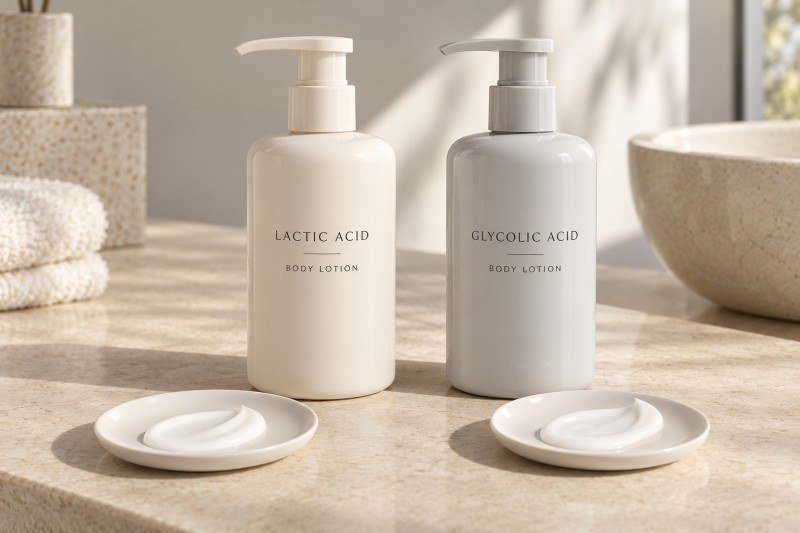
Lactic acid body lotion is often a good starting point when the goal is to smooth rough-feeling skin while maintaining a strong moisturizing focus. Glycolic acid body lotion often fits products that place exfoliation and surface texture refinement at the center of the concept.
Both ingredients are alpha hydroxy acids, commonly called AHAs. Both can support smoother-feeling, fresher-looking body skin.
The difference becomes more useful when you consider the person using the lotion. Is dryness the main concern? Does the product need to feel like an everyday moisturizer? Is the brand developing a more focused exfoliating step?
For a private label AHA body lotion, those decisions should guide the acid system, moisturizing base and finished texture.
Lactic Acid vs Glycolic Acid Body Lotion at a Glance
Lactic acid and glycolic acid share an exfoliating role, but they offer different formulation opportunities. Lactic acid has a useful moisturizing connection through lactic acid and lactate systems. Glycolic acid has a smaller molecule and is widely associated with exfoliation-focused skincare.
Neither ingredient alone determines how strong or comfortable the finished lotion will feel.
| Comparison | Lactic Acid Body Lotion | Glycolic Acid Body Lotion |
|---|---|---|
| Main development appeal | Exfoliation with a strong moisturizing story | Exfoliation-led surface smoothing |
| Molecular size | Larger than glycolic acid | Smaller than lactic acid |
| Moisturizing contribution | Lactic acid and lactate can contribute to moisture retention | Relies more on the supporting moisturizing system |
| Common product direction | Dry, rough-feeling skin and comfort-focused smoothing | Rough texture and dull-looking skin |
| Suitable textures | Lightweight lotion through rich cream | Lightweight lotion through rich cream |
| Main formulation priority | Balance smoothing, hydration and after-feel | Balance exfoliation, comfort and moisturization |
| What should not be assumed | Every lactic acid lotion is gentle | Every glycolic acid lotion is stronger |
What Is the Main Difference Between Lactic Acid and Glycolic Acid?
The clearest chemical difference is molecular size. Glycolic acid is smaller than lactic acid. This difference can influence how the ingredients interact with skin, although the complete formulation also affects their behavior.
Lactic acid offers another useful characteristic: its relationship with moisturization. Lactic acid and lactate systems can contribute to water retention, making them relevant to products that combine exfoliation with dry-skin care.
Glycolic acid is often selected when a brand wants a recognizable exfoliating ingredient to lead the product story.
These are starting advantages, rather than guarantees. A well-balanced glycolic acid lotion can feel comfortable and moisturizing. A poorly balanced lactic acid lotion can still cause irritation.
The finished product matters more than the reputation of either ingredient.
Why Lactic Acid Often Suits Dry, Rough-Feeling Skin
Dry body skin can feel uneven, coarse or less supple. An exfoliating lotion for this audience needs to improve surface feel while providing enough conditioning to remain pleasant after application.
Lactic acid is a useful starting direction because it can support both parts of that concept.
A lactic-acid-led body lotion may be developed around:
Smoother-feeling arms and legs
Softer-feeling rough areas
A more comfortable moisturizing finish
Reduced greasy residue
A clear exfoliating-moisturizer identity
The supporting base remains essential.
Glycerin and other compatible humectants help attract water. Emollients improve slip and softness. Selected lipid systems can strengthen the moisturizing role.
For this type of product, the most convincing experience is a lotion that feels nourishing enough to use consistently while gradually improving the feel of surface roughness.
When Glycolic Acid Is the Better Starting Point
Glycolic acid often makes sense when exfoliation is the main reason for developing the product.
A brand may want to offer a targeted body lotion for rough-feeling areas, a texture-refining evening product or a lightweight exfoliating moisturizer with a familiar active ingredient.
Its smaller molecular size helps explain its established place in exfoliating skincare. However, it does not mean every glycolic acid product will outperform every lactic acid product.
A glycolic-acid-led brief may prioritize:
A clearly defined exfoliating function
Smoother-looking body texture
Fresher-looking skin appearance
Lightweight application
A conditioned finish without heavy residue
The formula still needs a substantial moisturizing role.
A product that exfoliates but leaves an unpleasantly dry or tight sensation may be difficult to maintain in a regular routine.

Which Is Better for Rough or Bumpy-Looking Skin?
Both acids can be considered for cosmetic care of rough-feeling or bumpy-looking body texture. The useful distinction is what accompanies that roughness.
Roughness With Noticeable Dryness
A lactic-acid-led lotion with a more conditioning base may be a practical starting point.
The formula can give smoothing and moisturization similar importance, rather than treating hydration as a secondary benefit.
Roughness With a Preference for Lightweight Care
A glycolic-acid-led lotion may suit a more exfoliation-focused concept, provided the base still delivers adequate softness and moisture.
Lactic acid can also be formulated into lightweight textures. The acid choice does not dictate richness.
Roughness With Easily Irritated Skin
The priority should be a conservative formulation and appropriate evaluation of the complete product.
Switching to lactic acid alone does not establish sensitive-skin suitability.
Not every visible bump has the same cause. Cosmetic claims should describe smoother feel or improved texture appearance rather than promise to treat a skin condition.
Which Is Better for Dull-Looking Body Skin?
Both lactic acid and glycolic acid can support a fresher-looking skin surface through exfoliation.
For a brand developing a radiance-focused body lotion, the decision depends on the wider product experience.
A lactic-acid-led lotion may suit a concept built around softness, moisture and a supple-looking finish.
A glycolic-acid-led lotion may suit a concept that makes surface refinement the leading benefit.
In either case, the lotion base influences how the skin looks immediately after application. Emollients can create a smoother, more conditioned appearance, while excessive residue can make the finish feel heavy.
“Radiance” should also be distinguished from changing natural skin color. A cosmetic body lotion can focus on dullness and uneven-looking surface appearance without promising bleaching or permanent lightening.
Is Lactic Acid Always Gentler Than Glycolic Acid?
Lactic acid is often associated with gentler exfoliation, but that comparison needs context.
A low-exposure glycolic acid formula may be more comfortable than a lactic acid formula with a higher acid load, a lower pH or an unsuitable base.
Comfort depends on several factors:
Actual acid content
Final pH
Degree of neutralization
Other active ingredients
Fragrance and supporting ingredients
Frequency of use
Skin condition at application
For a comfort-focused product, lactic acid may be a reasonable direction to explore first. The sample still needs to demonstrate that the intended experience has been achieved.
A mild ingredient story cannot replace finished-product evaluation.
Why Acid Percentage Does Not Tell the Whole Story
Acid percentage is useful information, but it is an incomplete way to compare body lotions.
First, the number needs a clear definition. It may describe actual acid content, the addition level of a diluted raw material or the total amount of a multi-acid blend.
Those numbers are not necessarily equivalent.
Second, final pH and neutralization affect the acid system. Two lotions with the same acid content can have different proportions of unneutralized acid.
Third, the lotion base changes application, moisture retention and residue.
| Variable | What to Clarify |
|---|---|
| Acid percentage | Does it refer to actual acid content or raw-material addition? |
| Acid blend | How much does each acid contribute? |
| Final pH | What is the pH of the complete, equilibrated formula? |
| Neutralization | How has the acid system been adjusted? |
| Moisturizing base | Does it support the intended comfort and after-feel? |
| Use directions | How often and over what body area is it intended to be used? |
For product development, a clear target experience is more useful than requesting the highest possible percentage.
How pH Changes the Finished Lotion
Final pH influences the balance between an acid and its ionized form. It also affects the surrounding formula, including the performance of certain thickeners and preservation systems.
This makes pH relevant to both skin experience and product stability.
An AHA lotion can face problems such as:
Viscosity loss
Changes in spreading behavior
pH drift during storage
Emulsion instability
A different application feel over time
A useful development review checks the complete lotion after the formula has equilibrated and monitors changes during stability evaluation.
Lowering pH simply to make the product feel more active can create avoidable comfort and stability problems.
The objective is a controlled formula that performs consistently throughout its intended shelf life.
Texture Matters as Much as the Acid Story
Body lotion is often applied over a much larger area than facial skincare. A small amount of tackiness or drag can become more noticeable across the arms and legs.
The product therefore needs to work as a lotion, not just as a carrier for an acid.
Lightweight Lotion
Useful for easy spreading, warmer climates and users who dislike heavy residue.
The challenge is maintaining enough conditioning so the finish does not feel dry or insubstantial.
Silky Emulsion
Suitable for a balanced, premium body-care experience.
It can provide smooth glide and a soft finish without the weight of a richer cream.
Rich Comfort Lotion
Useful when dryness and roughness are closely connected.
The formula should remain easy to distribute and should not require excessive rubbing.
Gel-Lotion
Suitable for a fresh, modern sensory direction.
The thickening system needs to remain compatible with the acidic formulation.
Both lactic acid and glycolic acid can be explored across these texture directions.
Can Lactic Acid or Glycolic Acid Body Lotion Be Used Daily?
Some AHA body lotions are designed for regular use. Others are intended for less frequent application.
Daily suitability should follow the finished formulation, its evaluation and the intended directions.
A product brief should establish:
Whether the lotion is for broad body use or selected areas
Whether the intended audience is familiar with exfoliating products
How the lotion fits with other active products
Whether the moisturizing base supports repeated application
What instructions are needed if discomfort occurs
A rich texture does not automatically make an acid lotion mild.
A low-residue finish does not automatically mean it is suitable for daily use.
Brands should define the intended routine early, so the formula and labeling can be developed around the same expectation.
Shaving, Scrubs and Other Actives Can Affect Comfort
An AHA lotion does not operate in isolation.
The consumer may also use a body scrub, an exfoliating wash, a retinoid product or a hair-removal routine. These combinations can change how the lotion feels.
Shaving and Waxing
Freshly shaved or waxed skin may be more prone to stinging. Product directions should address its use around hair removal.
Physical Scrubs
Combining a strong scrub with an exfoliating leave-on product may make the overall routine harder to tolerate.
Other Exfoliating Acids
Layering several acid products can increase total exposure without providing a clear practical benefit.
Retinoid Body Products
A routine containing both retinoids and AHAs needs careful planning and clear instructions.
For a new body-care line, each product should have a defined role. More active steps do not automatically create a better routine.
Sun Protection Is Important With Both Acids
Lactic acid and glycolic acid body lotions both need appropriate sun-sensitivity communication.
The U.S. FDA’s guidance on AHA cosmetics recommends communicating that these products may increase sun sensitivity and the possibility of sunburn.
It also recommends advising sunscreen, protective clothing and limited sun exposure during use and for a week afterward.
This is particularly relevant to body products used on exposed arms, legs and shoulders.
Applying an AHA lotion at night does not remove the need to consider daytime sun exposure.
The final directions and warning statements should be reviewed for the destination market.
Can Lactic Acid and Glycolic Acid Be Combined?
A blended AHA body lotion can contain both lactic acid and glycolic acid.
This may be useful when a brand wants a particular exfoliation profile or a formula identity that is not centered on one acid.
However, a blend needs a purpose.
Combining acids does not automatically make the lotion more effective or more comfortable. It also adds formulation variables that need to be controlled.
Development should review:
The role of each acid
Total actual acid content
Final pH and neutralization
Moisturizing support
Sensory performance
Stability
Intended frequency of use
A single-acid lotion may be the clearer starting point when the brand has a specific audience and a straightforward product promise.
Packaging Should Match the Finished Formula
Packaging affects how easily the lotion becomes part of a routine.
A pump that dispenses too little can make full-body application frustrating. A pack that struggles with a rich lotion can leave too much product inside. Compatibility problems may also appear during storage.
| Packaging | Useful For | What to Check |
|---|---|---|
| Pump bottle | Broad body application and convenient dispensing | Output per pump, viscosity compatibility and leakage |
| Airless bottle | Controlled dispensing and a refined presentation | Evacuation performance and complete-pack compatibility |
| Squeeze tube | Portable formats and controlled application | Squeezability, closure performance and packaging MOQ |
| Jar | Richer textures and easy product access | Handling, closure compatibility and exposure during use |
The formula should be tested in the intended packaging.
For an acidic lotion, that includes the bottle or tube, closure, seals and relevant dispensing components.
Common Development Mistakes
Several avoidable decisions can weaken an otherwise promising AHA body lotion.
Choosing the Percentage Before the Product Goal
The formula should follow the intended smoothing experience, moisturizing role and routine.
Assuming Lactic Acid Guarantees Comfort
Acid load, pH and the complete base still matter.
Treating Stinging as Proof of Performance
A strong sensation does not establish better results.
Adding Too Many Active Ingredients
An overloaded formula can make compatibility, comfort and product communication harder to manage.
Neglecting the Moisturizing Base
An exfoliating lotion still needs to leave the skin feeling appropriately conditioned.
Approving Only the First Application
Samples should be assessed beyond initial slip, including absorption, tackiness and after-feel.
Choosing Packaging Before Checking Dispensing
Visual appeal needs to work alongside practical application.
Making Treatment Claims Without the Appropriate Basis
Cosmetic smoothing claims and claims to treat skin conditions require different regulatory consideration.
Which Should a New Body Care Brand Choose?
The best starting point is the product need the brand can explain clearly and support consistently.
| Product Goal | Direction to Explore | Main Priority |
|---|---|---|
| Moisturizing care for dry, rough-feeling skin | Lactic-acid-led lotion | Smoothing with a comfortable conditioned finish |
| A dedicated exfoliating body lotion | Glycolic-acid-led lotion | Surface refinement with adequate moisture support |
| Premium regular-use body care | Either acid system | Balanced texture, comfort and clear directions |
| A differentiated multi-acid concept | Lactic and glycolic acid blend | A defined role for each acid |
| Sensitive-skin positioning | Individual formula assessment | Evidence for the complete product |
For a first launch, one clearly positioned lotion is often easier to communicate than several products distinguished only by acid percentage.
A brand can expand later once sample feedback and market response show which additional product role is needed.
How Zerun Supports AHA Body Lotion Development
Shenzhen Zerun Cosmetics Co., Ltd. helps brands develop AHA body lotion around the intended product experience.
The starting point may be a lactic-acid-led moisturizing lotion, a glycolic-acid-led exfoliating lotion or a balanced AHA blend.
Development discussions can cover:
Target users and body-care positioning
Acid system and moisturizing support
Lightweight, silky or richer textures
Fragrance-free or scented directions
Packaging and dispensing requirements
Sample evaluation priorities
Stability and packaging compatibility evaluation needs
The most useful brief includes the target market, reference product, desired after-feel, packaging idea and expected quantity.
Explore our private label AHA body lotion development options to plan a formula direction around your brand.
Conclusion
Lactic acid often provides a useful starting point for body lotions that combine smoothing with a strong moisturizing role. Glycolic acid often fits products with a more prominent exfoliation and texture-refining identity.
Both can be developed into lightweight or richer lotions.
The final decision should consider the complete formula: acid content, pH, neutralization, moisturizing base, texture and intended routine.
Choose the direction that best matches the product experience your brand wants to deliver, then use sampling and evaluation to confirm that the finished lotion meets that brief.
More Related
Custom Formulations
Custom Brightening Formulations→
Custom Anti-Aging Formulations→
Custom Sunscreen Formulations→
Custom Acne Treatment Formulations→
Custom Sensitive Skin Care Formulations→
Custom Hair Growth Formulations→
Custom Anti Hair Loss Formulations→
Custom Smooth And Shine Hair Formulations→
Custom Anti Frizz Formulations→
Custom Hair Gloss Formulations→
Custom Anti Static Hair Formulations→
Custom Hair Moisturizer Formulations→
Custom Hair Nourishing Formulations→
Custom Hair Strengthening Formulations→
Custom Hair Damage Repair Formulations→
Custom Hair Volumizing Formulations→
Custom Hair Fluffy Formulations→
Custom Curl Defining Formulations→
Hot Private label Hair products
Private Label Hair Growth Oil→
Private Label Anti Dandruff Shampoo→
Private Label Anti Fungal Shampoo→
Private Label Luxury Hair Oil→
Private Label Lightweight Conditioner→
Private Label Peppermint Hair Oil→
Private Label Leave In Conditioner→
Private Label Curl Defining Cream→
Private Label Hair Volume Powder→
Hot ingredients
Custom cosmetic solutions
FAQ Categories
Can't find the answers?
No worries, please contact us and we will answer all the questions you have during the whole process of OEM beauty and skincare products customization.
Make A Sample First?
If you have your own formula, packaging idea, logo artwork, or even just a concept, please share the details of your project requirements, including preferred product type, ingredients, scent, and customization needs. We’re excited to help you bring your personal care product ideas to life through our sample development process.