Skip to content
What to include in a cosmetic manufacturing contract?
A contract only works when it does three things: set measurable standards, validate them with tests, and prove them with documents—before anything ships.
- Standard: lock scope, specs, packaging BOM, and release criteria in writing.
- Test: define stability, micro, compatibility, and transport checks with pass/fail rules.
- Document: list the exact files you receive for approval, release, and traceability.
The contract lock chain:Contract Framework → Scope Lock → QC Acceptance → Compliance Roles → IP Ownership → Total Cost & Lead Time → Remedies → Change Control & Exit
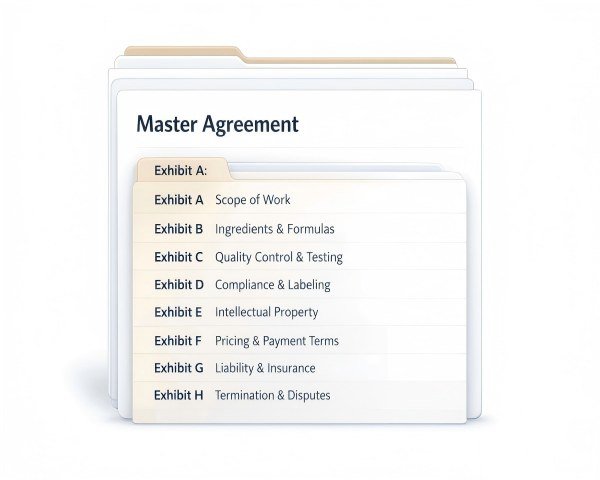
Contract Blueprint: 1 Master + 8 Exhibits (A–H)
Most contract disputes happen because the master agreement is generic and the operational details live in emails. A buyer-ready manufacturing contract uses a short master agreement for legal terms, and relies on exhibits to lock production reality—so scope, QC gates, documents, and change control are enforceable.
Think of it as “one legal shell + multiple operational locks.” The shell stays stable. The locks (exhibits) are version-controlled and updated when you change packaging, specs, or test plans—without renegotiating the whole contract.
What to include in the Master Agreement
- ✅Parties and definitions that match your supply chain roles (brand owner, manufacturer, subcontractors).
- ✅Term, renewal, and termination triggers tied to performance and delivery obligations.
- ✅Confidentiality, IP baseline, and permitted subcontracting rules.
- ✅Liability, warranties, indemnities, and insurance requirements.
- ✅Governing law, dispute resolution, and notice requirements.
What to include as Exhibits
- ✅Exhibit A: Product identity and finished product specs (what “pass” means).
- ✅Exhibit B: Packaging BOM and specs (what exactly is being used).
- ✅Exhibit C: Testing plan and release gates (what gets tested, when, and how it’s approved).
- ✅Exhibit D: Labeling and claims boundary (what you can say in-market).
- ✅Exhibit E: Documents and deliverables (what files you receive and by when).
- ✅Exhibit F: Commercials and lead-time assumptions (what price and timeline actually include).
- ✅Exhibit G: Change control (what cannot change without written approval).
- ✅Exhibit H: Remedies and recalls (what happens if something fails).
Master vs Exhibits
Master Agreement
- Defines legal responsibilities, confidentiality, IP baseline, and dispute handling.
- Sets term, payment principles, warranties, and liability/insurance requirements.
- Stays stable across SKUs and only changes when the relationship terms change.
Exhibits (Operational Locks)
- Lock scope, specs, packaging BOM, tests, documents, and release criteria.
- Define change-control rules so nothing “similar” is swapped without approval.
- Version-controlled and updated when your product, packaging, or test plan changes.
Rule: If it’s not in the exhibits, it’s not locked.
5-step build order:Step 1 Scope(A+B)→ Step 2 Quality(C+D)→ Step 3 Samples(E)→ Step 4 Compliance(F)→ Step 5 Cost & Change Control(G+H)→ Finish(Master terms)
Five-step build order
Step 1 — Lock scope first (Exhibit A + B)
Output: A complete product spec + packaging BOM that makes quotes truly comparable.
Next: Once scope is locked, you can set quality targets that match the real product.
Step 2 — Lock quality reality (Exhibit C + D)
Output: QC targets, test methods, and release rules that define “pass to ship.”
Next: Once quality gates are written, you can approve samples with clear acceptance criteria.
Step 3 — Lock sample acceptance (Exhibit E)
Output: Written sample approval rules that prevent bulk drift disputes.
Next: Once acceptance is defined, you can assign compliance and labeling responsibilities without gaps.
Step 4 — Lock compliance ownership (Exhibit F)
Output: A responsibility matrix for claims, labels, documents, and market requirements.
Next: Once responsibilities are clear, you can finalize total cost and prevent “cheap quote” traps.
Step 5 — Lock total cost + change control (Exhibit G + H)
Output: A comparable total-cost schedule and written rules for any future changes.
Finish: Attach remedies, recall cooperation, and exit terms in the Master Agreement.
Step 1 — Scope (Exhibit A + B)
Lock what is being made, in what format, with what packaging, and what documents are included. If scope is vague, price is meaningless.
Scope checklist
| Field | What to lock (one clear line) |
|---|---|
| Product list | List every SKU and link each one to an approved sample ID or reference code. |
| Net content | Specify net weight/volume per unit and the fill tolerance that counts as acceptable. |
| Formula type | State stock vs custom, key performance targets, and when re-approval is required after any change. |
| Packaging BOM | Itemize every component (bottle/jar, pump/cap, liner/seal, carton, label) with material and part number. |
| Documents | Define the exact documents included (INCI, COA, SDS, spec sheet, micro results, stability summary if applicable) and delivery timing. |
| Services included | Clarify what the price includes (filling, labeling, boxing, shrink wrap, carton packing, palletizing, sampling rounds). |
| Exclusions | List what is not included (tooling, artwork setup, testing fees, compliance filings, freight, duties, storage, rework). |

If a quote can’t show this scope in writing, treat it as incomplete.
Step 2 — Quality & Release (Exhibit C + D)
A good contract defines pass/fail targets, who tests what, and what happens if results fail. This turns “we’ll do QC” into measurable release criteria.

Watchlist ( key points)
- ✅Finished product specs must be measurable (not “looks good”), with clear tolerances.
- ✅Define micro limits, test methods, and what counts as pass/fail for release.
- ✅Specify who tests what (factory lab vs third-party lab) and when results are due.
- ✅Set incoming QC rules for key raw materials and packaging components.
- ✅Define in-process controls that prevent drift (temperature, mixing time, fill weight checks).
- ✅Require retention samples and record retention periods for investigations.
- ✅Lock packaging compatibility expectations for pumps, liners, and label adhesion.
- ✅Define a release package: which documents must exist before shipment is approved.
- ✅Add a failure pathway: re-test, rework, replace, credit, and the decision timeline.
- ✅Require written approval for any deviation, with a CAPA-style corrective action summary.
| Gate | What is checked | Pass/Fail target | Who tests | Evidence required before release |
|---|---|---|---|---|
| Incoming | Key raw materials + packaging components | COA matches spec; packaging meets BOM specs | Supplier + factory QC | COA + incoming inspection record |
| In-process | Critical process controls during manufacturing | Process parameters within agreed ranges; fill weight within tolerance | Factory QC | Batch record + in-process check sheet |
| Finished | Final product quality + safety checks | Spec targets met (pH/viscosity/appearance/odor); micro within limits | Factory + (optional) 3rd-party | Finished product spec sheet + micro report |
| Stability | Shelf-life + packaging performance over time | No unacceptable drift; packaging remains functional | 3rd-party or agreed lab | Stability summary + compatibility notes |
Step 3 — Samples (Exhibit E)
A sample only protects you when “approved” has written acceptance criteria. Exhibit E turns your approved sample into measurable rules—so bulk must match what you signed off, not a supplier’s “equivalent.” Use this as the bridge between paper specs and production reality.
Watchlist
🔒Approved sample ID: Lock the sample code/date/version and who approved it.
🔒Golden sample retention: Both parties keep sealed golden samples for a defined period.
🔒Key measurable specs: Set target ranges for 3–6 specs (e.g., pH, viscosity, fill weight).
🔒Appearance and odor rules: Define what “acceptable” looks/smells like and what counts as off.
🔒Packaging function checks: Require leakage, pump output, cap torque, and label adhesion checks.
🔒Deviation rule: Define what counts as a mismatch vs acceptable variance within spec.
🔒Re-sample triggers: Any change in raw materials/fragrance/packaging/process triggers re-sampling.
🔒Shipment hold + remedy: No release until Exhibit E gates pass, with clear rework/replace/credit rules.

| Exhibit E item | What to lock (one sentence) | Evidence required | Pass/Fail rule |
|---|---|---|---|
| Approved sample ID | Lock sample code/date/version and sign-off names. | Signed approval + reference photos. | No sign-off = no production release. |
| Golden samples | Keep sealed golden samples on both sides for a defined period. | Retention log + sample count. | Missing retention = re-sample required. |
| Measurable specs | Define target ranges for pH/viscosity/fill weight (3–6 items). | Batch QC report. | Out of range = hold batch. |
| Sensory rules | Define acceptable appearance/odor/feel and “must-not” defects. | QC notes + comparison photos. | Off-odor/defect = reject or rework. |
| Packaging function | Confirm leakage, pump output, cap torque, label adhesion. | Function test records + photos. | Any fail = rework/replace. |
| Deviation rule | Define what changes count as mismatch vs acceptable within spec. | Change record + written approval. | Unapproved change = reject. |
| Re-sample triggers | List changes that force re-sampling (raw/fragrance/packaging/line). | Change control record. | Trigger hit = sample gate again. |
| Shipment hold | Release only after Exhibit E gates pass and records are issued. | Release sign-off + docs pack. | No docs = no shipment. |
| Failure remedy | Define rework/replace/credit options and timelines. | CAPA plan + re-sample result. | Miss timeline = credit/replace. |
If a quote can’t show this scope in writing, treat it as incomplete.
Card 1 — Mismatch examples
- Odor drift: Bulk smells sharper/weaker than the approved sample due to fragrance or raw-material lot changes.
- Pump leak: The formula is fine, but the pump/inner seal fit causes seepage during transport or storage.
- Viscosity shift: Bulk feels thinner/thicker than the sample, changing spread, finish, and dosing.
Card 2 — Re-sample triggers
- Raw: Any supplier/grade change for a key raw material.
- Fragrance: Any change to fragrance oil, dosage, or allergen/IFRA category inputs.
- Packaging: Any change to bottle/pump/cap/liner material, spec, or supplier.
Card 3 — Failure outcomess
- Hold: Stop release and quarantine the batch until investigation and retest are completed.
- Rework: Adjust, re-filter, re-fill, or re-pack only with written approval and new QC evidence.
- Replace-or-credit: Replace nonconforming goods or issue credit based on the agreed remedy timeline.
Step 4 — Compliance (Exhibit F)
Define who owns claims, label review, ingredient restrictions, and market-specific documentation. Compliance gaps usually show up late—and cost the most.
Responsibility matrix (RACI)
Legend: R = Responsible (does the work) / A = Accountable (final owner) / C = Consulted (advises) / I = Informed (kept in the loop)
| Topic | Brand | Manufacturer | Lab / Testing partner | Packaging supplier |
|---|---|---|---|---|
| Target market route (US/EU/UK/etc.) | A | C | I | I |
| Claims strategy and claims boundary | A | C | C | I |
| Label content and required elements | A | C | I | C |
| Ingredient restrictions screening for target market | A | R | C | I |
| Fragrance / allergen statements (if used) | A | R | C | I |
| INCI list confirmation and version control | A | R | I | I |
| Safety / compliance documents pack list | A | R | C | I |
| Micro testing plan and release criteria | C | A | R | I |
| Stability / compatibility test plan (if required) | C | A | R | C |
| Packaging-material compliance statements | I | C | I | A/R |
| Label proof approval workflow and sign-off | A | C | I | C |
| Record keeping (what is archived, how long) | A | R | C | I |
| Change impact review (formula/packaging/claims) | A | R | C | C |
| Market-specific pre-launch checklist | A | R | C | I |
Do
✅Use cosmetic-friendly benefit language tied to appearance and feel (e.g., “helps improve the look of…”).
✅Keep claims consistent across Title, A+, PDP, and packaging.
✅Require written claim review before print and before production.
Don’t
⛔Use disease, treatment, or medical outcome language unless you have a regulated plan.
⛔Mix “cosmetic” claims with drug-like outcomes on the same SKU content set.
⛔Approve packaging print before the compliance document pack is confirmed.
Step 5 A— Commercials (Exhibit G)
Low prices often hide missing items: packaging specs, print set-up, testing, and rework terms. Break commercial terms into unit cost, one-time fees, and optional services.
True Total Cost View
| Cost bucket | What must be stated in writing | Typical hidden-cost trap |
|---|---|---|
| Unit price (per unit) | What the unit price includes (fill, cap/pump assembly, labeling, boxing, carton packing) and what it excludes. | A low unit price that excludes basic packing steps you assumed were included. |
| Packaging components | Component-level BOM pricing (bottle/jar, pump, cap, liner, carton, label) with part numbers. | “Packaging included” with no part numbers, then a re-quote after artwork approval. |
| Printing & decoration | Plate/tooling fees, print set-up, proofs, color matching rules, and reprint responsibility. | Set-up fees appear later, or color rework is billed to the brand by default. |
| Testing fees | Micro, stability, compatibility, transport/leak testing (if needed) and who pays which tests. | Tests are “recommended” later and become mandatory to ship or to list. |
| Sampling & iterations | Sample fees, number of included rounds, and pricing for extra rounds or reformulation. | Endless paid iterations because acceptance criteria were never defined. |
| Rework and failure handling | Who pays for rework/retest/repack when batches fail specs and what timelines apply. | “We will handle it” with no cost allocation, then you pay the logistics. |
| Freight & logistics | Incoterms, destination, pallet/carton specs, and who pays storage/demurrage if delays happen. | Unplanned storage and port fees when documents or approvals slip. |
| Optional services | Clear pricing for extras: compliance support, third-party audits, extra documents, retail-ready packing. | Bundled “support” that becomes chargeable item-by-item during execution. |
| Currency & validity | Currency, exchange assumptions, quote validity window, and re-quote triggers. | Price changes after you approve samples because validity was not stated. |
| Volume tiers | Tiered pricing by quantity and what qualifies as a tier (per SKU vs combined). | You assume blended volume, but the factory prices per SKU and per component MOQ. |
MOQ reality
- Separate product MOQ and packaging MOQ, and state which one controls the first run.
- Confirm if MOQs are per SKU, per color, per decoration, or can be combined.
- Define re-order MOQ rules once packaging components are already stocked.
Lead-time assumptions
- Break lead time into packaging sourcing, printing, production, testing, and release approval.
- State what pauses the clock (artwork approval, payment, test results, component delays).
- Require a written schedule update rule when any assumption changes.
Payment milestones
- Tie deposits and balances to measurable milestones (sample approval, packaging proof approval, batch release).
- Include a “hold” rule: shipment cannot be released without the release document pack.
- Define what happens to payments if batches fail specs (credit, rework, or replacement timing).
Step 5B— Change Control (Exhibit H)
Most quality drift comes from untracked changes—raw materials, packaging, process settings, or subcontractors. Define change approval, version control, and what happens at termination.
Change control watchlist
⚠️Raw material change: any supplier/grade swap must be disclosed and approved before use.
⚠️Fragrance change: any fragrance house, formula, or allergen profile change triggers review and re-approval.
⚠️Active level change: any adjustment to key actives or preservative system requires written approval and risk review.
⚠️Packaging component change: bottle, pump, liner, carton, or label material changes require a BOM update and approval.
⚠️Pump output / orifice change: any change that affects dosing or spray pattern requires compatibility confirmation.
⚠️Process setting change: mixing order, temperature, hold time, and fill window changes must be logged and approved.
⚠️Line / site change: production line or factory site changes require prior notice and approval.
⚠️Subcontractor change: any new subcontractor must be disclosed and approved in writing.
⚠️Test plan change: removing or shortening tests requires written sign-off and documented rationale.
⚠️Document versioning: every spec/BOM/test plan has a version number, date, and approval record.

Termination essentials
- Define what gets handed over: latest specs, BOM, INCI, test summary, and artwork/tooling files.
- Define timelines and fees for release of tooling and deliverables (if any).
- Define remaining inventory handling: WIP, finished goods, and retained samples.
Master — IP & Confidentiality
If you ever need to move production, your contract must define who owns the formula, specs, molds, artwork, and data. Clear ownership prevents “hostage by process”.
Brand-owned
- Brand name, logos, trade dress, and all marketing assets.
- Label artwork files and final print-ready files you paid to create.
- Product concept, positioning, and any consumer research or feedback data.
- Product specs you approve (finished product targets, QC release criteria).
- Supplier list and approved component list you curated for the project.
- Regulatory/compliance files you commissioned (where applicable) and final label copy versions.
Factory-owned
- Factory’s base formulas and manufacturing know-how used as starting points.
- Internal process parameters, SOPs, and proprietary mixing techniques.
- Factory-owned molds/tooling they funded and maintain for general use.
- Their internal QC templates, line records format, and shop-floor documents.
- Supplier contracts that are in the factory’s name (unless assigned to you).
- Their confidential cost structure and internal pricing models.
Exit-ready checklist
- A written handover pack is delivered upon request: latest INCI, specs, BOM, and test summary.
- Artwork and tooling release rules are defined, including any fees and timelines.
- A clear “no withholding” clause: deliverables cannot be held back if invoices for agreed milestones are paid.
- The manufacturer must support one transition batch or tech transfer window under agreed terms.
- All versions are controlled: every change has a date, reason, and approval record.

Master — Remedies, Recalls & Termination
A contract should specify remedies for defects, who pays for rework, returns, and recalls, and what insurance is required. This is how buyers “buy certainty,” not just product.
Risk clause checklist
- Defect definition: define defects in measurable terms (spec failure, leakage, contamination, mislabeling) and what evidence is acceptable.
- Remedy options: specify rework, replacement, credit, or refund—plus timelines and who pays shipping.
- Recall cooperation: define notification timelines, traceability support, and how recall costs are allocated.
- Insurance: require product liability coverage with clear limits and a valid certificate on request.
- Indemnity: define who covers losses caused by manufacturing defects, labeling errors, or unauthorized changes.
Worst-case scenario timeline
- Step 1: Notify + quarantine — the brand notifies the factory, stops shipment, and isolates affected lots.
- Step 2: Investigate + document — the factory provides traceability, batch records, and root-cause findings within a set timeline.
- Step 3: Decide remedy — both sides agree in writing on rework/replacement/credit and the logistics plan.
- Step 4: Prevent repeat — change control + CAPA actions are documented before the next production run.
Send one brief, get comparable contract-ready terms
Send your product + packaging brief, target market, and testing expectations. We’ll return a contract exhibit pack you can use to align quotes and avoid scope gaps.
What you’ll send
- Product list and target formats (SKU, net content, reference sample if you have one).
- Packaging BOM intent (bottle/jar + pump/cap + label/carton preferences).
- Target market and channel (e.g., US Amazon, EU retail, clinic, DTC).
- Quality gates you expect (specs, micro limits, stability/compatibility needs).
- Timeline and estimated order quantities (first run + reorder plan).
- Our team will answer your inquiries within 12 hours.
- Your information will be kept strictly confidential.